
The Sirohi is the goat you see most often behind a meat farmer's shed across Rajasthan and Gujarat, and it has spread well past that home ground for one plain reason: it survives where softer breeds struggle. It gains weight on scrub, crop stubble and kitchen leftovers, shrugs off real heat, and does not need the fussing a high-yield dairy breed demands. That toughness is why it is the breed most first-time goat farmers in a dry district are told to start with.

Where the Sirohi comes from
It takes its name from the Sirohi district in the south-west of Rajasthan, and its home tract runs from there across into the Palanpur side of Gujarat. From that base it has been carried all over India — partly on its own merits, and partly because it is used to upgrade smaller local goats. Put a Sirohi buck on a native doe and the kids come out bigger, so the breed travels wherever someone wants heavier meat animals out of the stock they already own.

How to spot a Sirohi
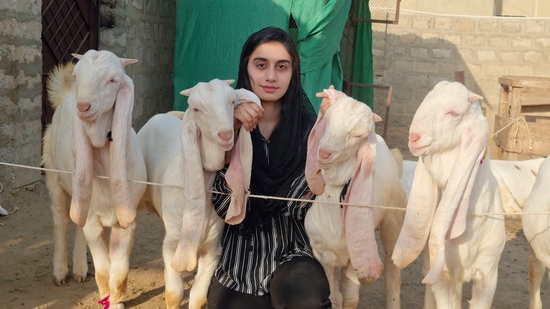
Compact, medium-sized, with short thick hair that is predominantly brown — usually broken up with light or dark brown patches, though the odd animal is nearly all white. The ears are the easy tell: flat, leaf-shaped and drooping. Most animals are wattled, the horns are small and curve up and back, and the tail is short and turned up.
On weight, be a little careful with market talk. The FAO's survey of Indian goat breeds puts a mature buck at roughly 50 kg and a doe at roughly 23 kg. Farmers on good feed quote more than that — bucks of 50 to 60 kg and does of 25 to 40 kg are common claims at a mandi — so take the higher figures as well-fed animals, not the breed average.

Meat, milk and kidding — the honest version
The Sirohi is sold as dual-purpose, but be clear-eyed: it is first a meat goat. Kids reach slaughter condition by about six months and dress out at close to 47 percent, a solid return for the feed. The milk is modest — a lactation of around 71 kg over roughly 175 days, which works out to a little under half a litre a day, more at the peak and tailing off after. Enough for the kids with a little to spare, not a dairy income.
Twinning is where the sales pitch and the survey data part ways. Sellers will tell you the Sirohi twins freely; the FAO farm survey actually recorded mostly single kids, with only about one litter in twelve coming as twins. Good feeding and management do lift that, so both stories can be true at once — just don't pay a premium expecting twins as the rule. Kids are born at about 2 to 2.5 kg, and a doe is best bred once she is well grown rather than at a fixed age.

Why farmers keep coming back to it
Hardiness is the whole case. It handles heat and dry spells, and will walk out to graze on browse and crop residue that pickier breeds leave behind. Kept clean, given shade and water, and dewormed on a sensible schedule, it rarely gives trouble. For a first-time farmer, or anyone in a low-rainfall belt, that counts for more than a few extra kilos or litres from a breed that needs babysitting.
What it costs, and what to check before you buy
Price swings hard with age, weight, sex and whether the animal is a genuine purebred or a cross — the box at the top of this page shows what sellers on Animalsss have actually been asking for Sirohi goats, which is a better guide than any single quoted rate.
When you go to buy, a few minutes of checking saves the usual mistakes. Read the age off the teeth rather than trusting the seller's word. Look for a bright, tight coat and clear eyes. Feel the udder on a doe and both testicles on a buck. And if you are paying purebred money, ask to see the parents or the seller's other Sirohis — a well-grown cross sold as pure is the commonest way a buyer overpays.

Breed figures here are drawn from the FAO's survey of the sheep and goat breeds of India; the prices are asking prices posted by sellers on Animalsss, not an official market rate.


 Menu
Menu
💬 Comments
Login to comment
No comments yet. Be the first to share your experience!