What "Sindhi horse" actually refers to
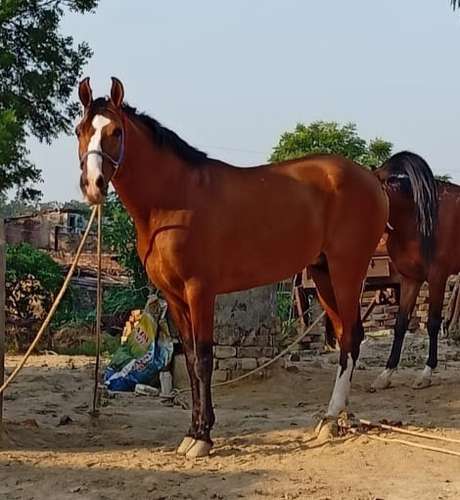
"Sindhi horse" is a regional name more than a tidy breed label. It points to the horses of the Sindh–Kutch–Gujarat borderland, and on the Indian side the animal the name usually lands on is the Kachchhi-Sindhi (also written Kutchi-Sindhi). That one is a genuinely recognised native breed: ICAR's National Bureau of Animal Genetic Resources has accessioned it (accession no. INDIA_HORSE_0417_KACHCHHISINDHI_07007), and it counts among India's seven recognised horse breeds alongside the Marwari, Kathiawari, Spiti, Zanskari, Bhutia and Manipuri. Its breeding tract is the Kutch, Surat and Navsari districts of Gujarat and the Jaisalmer–Barmer belt of Rajasthan.
Where honesty matters: the name is used loosely. Wikipedia's own entry on the Sindhi horse is a short stub that lists several overlapping types on the Sindh side — Arabi, Samoundi, Sindhi-Kathiawari and Sindhi-Katchi — with almost no hard data attached. Even the ICAR scientists who studied the Kachchhi-Sindhi wrote plainly that "literature on phenotypic characterization... is very scanty." So this is not a breed with a deep, centuries-old studbook. There is a real recognised horse behind the name, but the documentation is thin and the label gets stretched across a lot of similar desert horses.

What the breed data honestly supports
The little that is properly measured comes from the ICAR-National Research Centre on Equines and the Indian Journal of Animal Research. Their phenotypic work (Pal et al., 2021) puts the average horse at about 148 cm at the withers — roughly 14.2 hands — with a body length near 140 cm and a heart girth around 165 cm. The features they record are a Roman (convex) nose; ears that curve at the tips but, unlike the Marwari and Kathiawari, do not meet; a short back and short pasterns; and a broad hoof that grips loose desert sand. Coats are most often bay or chestnut, and the temperament is described as docile.
It is a desert horse by adaptation, hardy in the dry Kutch and Thar country, kept largely by pastoralist (Maldhari) families for riding, transport, moving livestock and local racing. It is also known for the "Rewal chal," an ambling gait that is smoother to sit than an ordinary trot. One sober note from the same research: the population is small — estimated at roughly 4,000 — and reported to be declining, which is why the breed is treated as one to conserve rather than one you will find on every corner.

Buying one in a real market — what to actually check
Because the label is loose, start there. A horse sold as "Sindhi" may be a Kathiawari cross, a local country-bred, or a plain desert horse wearing a fancier name. Ask where it was actually bred — the Kutch or Jaisalmer tract, or vaguely "from a village"? — and see the dam or sire if the seller has them. Most animals carry no breed-society or NRCE paperwork at all; that is the honest norm here, so don't pay a premium for the word "Sindhi" by itself.
Then check the horse, not the sales pitch:
- Age: read it off the teeth. Young horses have cupped incisors; the permanent mouth is in by around five, and after that the slope of the incisors and Galvayne's groove give a rough age. The mouth and the stated age often disagree — trust the mouth.
- Soundness and gait: have it walked and trotted on hard ground both ways. You want even, unhurried strides and no head-bob, which signals lameness. If it is being sold on its Rewal chal, ask to see that too — but judge the legs, not the show.
- Legs and hooves: run your hands down each leg feeling for heat or swelling, and pick up every foot. A broad, hard hoof is the breed's whole selling point, so cracked, neglected or under-run feet are a red flag and a slow, costly fix.
- Eyes, wind and condition: clear eyes with no discharge, quiet breathing after work, decent body condition, and no old saddle or harness sores.
- Temperament: handle it yourself — lead it, pick up its feet, touch the ears and girth. The breed's reputation is calm; a horse that won't stand to be handled is either badly kept or misrepresented, and either way it becomes your problem once the money is paid.
Finally, ask for papers: vaccination and deworming history, and — for any horse crossing state lines — the vet certificate and movement documents. Glanders is a notifiable disease in Indian equines, so insisting on a recent health check is reasonable, not rude.
What it will cost
Price tracks the individual horse far more than the label — age, soundness, training and any real pedigree move it much more than the word "Sindhi." For a live sense of the market, the box at the top of this page shows what sellers on Animalsss have actually been asking for Sindhi horses, which is a better guide than any single quoted rate.
Breed details here are drawn from the ICAR-National Research Centre on Equines / Indian Journal of Animal Research characterisation work and the Wikipedia entry on the Sindhi horse; reliable, standardised breed documentation for this horse is genuinely limited, so anything not sourced above has been left out rather than guessed.
 Menu
Menu
💬 Comments
Login to comment
No comments yet. Be the first to share your experience!