You have a bit of land, maybe some brush you are tired of fighting, and someone told you goats would clear it. Or you heard that goat meat sells in the cities and wondered if there is a business in it. Then you start looking for straight answers and everything goes fuzzy. How big do they get? What do you do with all the buck kids? What kind of fence holds them? And who actually buys the meat?
Here is the honest starting point. Worldwide, goats are an ordinary farm animal. In 2022 there were more than 1.1 billion goats, of which 150 million were in India. In the United States, goats are still a niche animal. That single fact changes how you should plan. You cannot assume a buyer will show up the way one does for beef or milk. You have to go and find your buyer first.
Start with the buyer, not with the goats
Goat has historically been less commonplace in American and Canadian cuisines. But it has become more popular in some niche markets, especially those serving immigrants from Asia and Africa who prefer goat to other meat. Goat meat in the West was once confined to ethnic markets. Now it also turns up in a few upscale restaurants and purveyors, especially in cities such as New York City and San Francisco. Certain Costco stores are known to keep whole frozen goats.
Mexican cooking is another outlet. Cabrito is baby goat, typical of Monterrey, Nuevo León, usually slow roasted. Birria is a spicy goat stew. Cabrito entomatado is another dish built around goat. And goat has its own American celebration: Brady, Texas has held its Annual World Championship BBQ Goat Cook-Off every year since 1973.
People do not all rate the meat the same way, and you should know that before you build a plan around taste. Some butchers say customers describe goat as gamey and not necessarily tastier than lamb, and that quality has been inconsistent because much of the supply came from culled wild goats. Other producers push back hard: one argues there is more to goat than curry, and makes goat salami. On top of that, so-called conscious consumers in America have been assessed as seeing wild-caught rangeland goat meat as more environmentally sustainable and healthy than other red meats.
Two words you will hear
- Chevon. This word for goat meat was coined in 1922 and adopted by the United States Department of Agriculture in 1928. It never caught on, and you will not really run into it in the United States.
- Mutton. Usage splits. Some people call goat meat mutton, and in South Asian cooking goat meat is called mutton. Others use mutton only for sheep meat and keep goat meat as its own separate product. In this guide, mutton means sheep meat and goat meat is called goat meat.
What about prices?
This is where you need to be careful, because nobody can hand you a number to plan against. Our own price records for the United States run to 254 rows, and they cover chicken meat, cattle meat, hen eggs, cow milk, turkey meat, pig meat and honey. There is no goat line at all — no goat meat and no goat milk. The nearest reference points we hold, all per tonne and most recently dated 2025-01-31, are cattle meat at USD2425 lowest, USD4387 highest and USD3448 average across 49 rows, and cow milk at USD381 lowest, USD600 highest and USD499 average across 38 rows. Those are not goat prices and should not be treated as goat prices. For what goats actually fetch near you, ring the buyers, butchers and dealers in your own area and ask them directly, before you buy a single animal.
Choose a breed for the job you have
Decide first what you want the goats to do — meat, milk, fibre, brush clearing, or bringing visitors onto the farm. Then pick the animal to suit.
How big will they get?
The size range across breeds is huge, more than five-fold from top to bottom:
- Bucks of larger breeds such as the Boer go over 140 kg (310 lb).
- Does of smaller breeds run 20 to 27 kg (44 to 60 lb).
- Miniature breeds sit at the bottom. The African Pygmy stands 41 to 58 cm (16 to 23 in) at the shoulder as an adult.
Even inside one breed, different strains or bloodlines may have different recognised sizes. So ask the breeder about the specific line you are buying, not just the breed name.
Breeds that show up on working farms give you a feel for the choices. Saanen, a Swiss mountain breed, is used at scale — South Africa's Fairview winery runs a herd of 750 Saanen, and Illinois farmers David and Marcia Johnson started with 11 Saanen goats bought in 2000 for their Shelby County farm near Findlay, now called Goat Tower Farm. Nigerian Dwarf goats are kept at Hampton Roads Winery in Surry, Virginia. Anglo-Nubian goats are kept at Finca el Rocío in Argentina, and pygmy goats at Cholmondeley Castle Gardens in the UK. For fibre, the breeds raised are cashmere and Angora goats.
What no breed name will tell you is how that animal handles your summers, your parasites or your forage. Heat tolerance, worm resistance and real milk or meat output under your conditions vary too much to generalise. Ask breeders in your own region and your own vet which lines are doing well locally.
The animal you are feeding
Goats are browsers and ruminants, with a four-chambered stomach made up of the rumen, reticulum, omasum and abomasum, and they are even-toed ungulates. A doe's udder has two teats, not four like a cow — the Boer goat is the exception and sometimes may have up to eight. Their pupils are horizontal and slit-shaped, which lets them see well in bright light and in the dark and gives them a wide field of view for spotting predators. They also have no tear ducts.
One "goat" you cannot farm
If someone offers you Rocky Mountain goats, walk away. The mountain goat, Oreamnos americanus, is not a member of Capra, the genus that holds all true goats. It is allied with goat-antelopes such as the chamois, gorals, takins and serows. Your farm goat is the domestic goat, Capra hircus, domesticated from the wild goat Capra aegagrus of Southwest Asia and Eastern Europe. Wild mountain goats live in the Rocky Mountains and Cascade Range from Washington, Idaho and Montana northwards, with introduced populations in Idaho, Wyoming, Utah, Nevada, Oregon, Colorado, South Dakota and the Olympic Peninsula of Washington. They cope with winter temperatures as low as −46 °C (−51 °F) and winds of up to 160 kilometres per hour (99 mph) — but they are wildlife, not livestock.
Plan for the buck kids before your does ever kid
One male can breed with many does, so there is not great demand for male goats. As one guide puts it, not one in a hundred males can be kept, profitably, as a herd sire. Only a small share of males are needed for breeding. Many of the rest are castrated for ease of control, and the most prominent use for males is meat.
Buck smell is a real management problem, not a story. Buck goats take on a unique and strong odour during the rut, which rams do not. The word hircine is used most often to point at that distinct goat smell. Intact bucks are notoriously smelly to people in the rut, and they will urinate on nearby objects and on themselves. That is a large part of why wethers, not bucks, are the usual choice when goats are kept as pets or around visitors.

Castration: when, how, and what can go wrong
Timing follows your slaughter plan. If the animal is going to be slaughtered very young, at around 5-6 months of age, there is no need to castrate. Animals kept longer, to an age of 6-12 months, are generally castrated. Slaughterhouses prefer handling castrated males and will usually pay more for them, and in goats castration also avoids a buck odour in the meat.
The value question does cut both ways, so weigh it yourself. Intact rams carry more muscle and less fat than ewes and wethers, and some people believe intact males have a more intense flavour — which is why ram meat is worth slightly less than wether meat. So some producers see the leaner intact carcass as an advantage, and others take the discount and the smell as reasons to castrate.
Fibre goats are handled differently. Cashmere and Angora goats are often castrated later in life than meat wethers, around 6 months of age rather than 3–4 weeks.
The three methods
- Surgical. A scalpel or emasculator is used to cut out the testicles.
- Burdizzo. The tool crushes the blood vessels supplying the testicles, so they wither.
- Elastration. Tight rubber bands go over the scrotum above the testes; the testicles atrophy and fall off weeks later.
Risks to manage
- Tetanus. Castration creates a wound, which raises the risk of tetanus from Clostridium tetani. Tetanus vaccines are recommended.
- Parasites and flies. Screwworms are a greater risk right after the procedure. In sheep, a castration wound can also attract flystrike and maggots, especially in warm weather. Fly repellant helps, and so does simply avoiding the warm months for the job — worth planning around if you farm in the southern states.
- Doing it too early. Castration at less than 4 weeks of age can increase the risk of urinary calculi, also called water belly or urolithiasis, because the urethra does not grow to its intended size.
Which method suits your herd, and exactly when to do it, is a conversation to have with a vet near you before your first kids arrive.
Fencing and shelter: assume they will climb everything
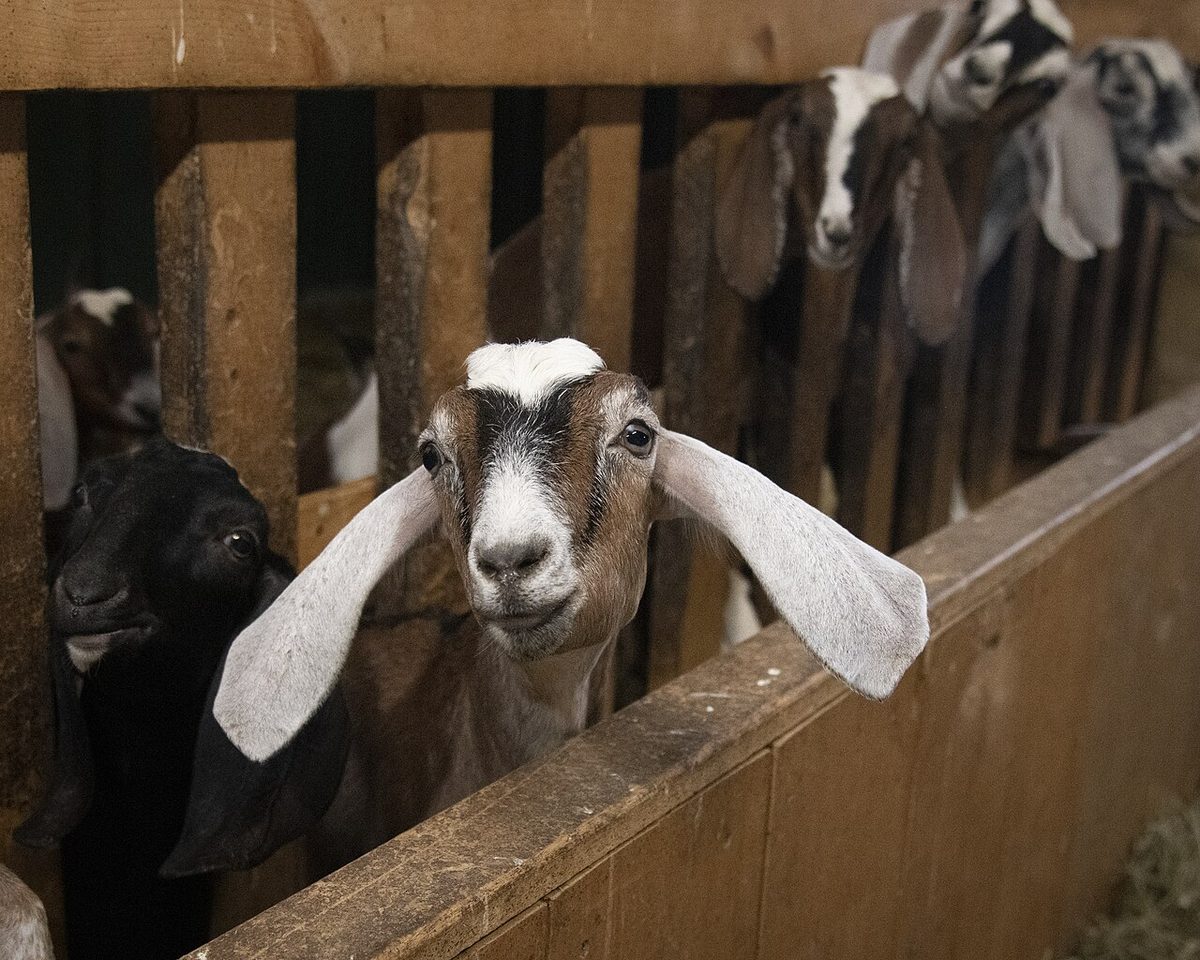
Goats are naturally curious, agile, and able to climb and balance in precarious places. They are the only ruminant that regularly climbs trees. Build your fences and pens around that, not around what would hold a cow. As David Johnson in Illinois says of his own herd: "Goats are the most curious animals in the world so they use the tower a lot. They come and go, passing each other on the ramp."
That climbing habit is why some farms give goats something to climb on purpose. Goat towers are multi-story goat houses with climbing ramps spiralling up the outside. The Johnsons' tower in Shelby County, Illinois is 31 feet tall (9.4 m) and 8 feet in diameter (2.4 m), six stories high, built from 5000 hand-made bricks with 276 steps of concrete slabs reinforced with rebar. Hampton Roads Winery in Surry, Virginia claims the tallest at 34 foot (10 m). Henly Hills Farm in Dripping Springs, Texas built a simpler three-story version in 2018 from cinder blocks and masonry, with a sloped metal roof and wooden blocks as steps, for a rescued herd. A petting zoo in Waunakee, Wisconsin has a steel tower built by the Endres Manufacturing Company in a Bavarian style, and the Maryland Zoo put up a climbing structure it calls a goat castle in 2019.
Keep this in proportion. A family member of the original Portuguese builders calls the towers "artistic daydreams with no functional explanation." They are eye-catching, and clearly goats enjoy them, but they are not a shelter specification. Floor space per goat, ventilation, bedding, kidding pens and what your shed needs for a hot southern summer or a cold northern winter all depend on where you farm. Go and look at two or three goat sheds in your county, and ask a local vet or an experienced breeder what works in your climate before you build.
Wethers, brush and other ways to earn
If your goal is land management rather than breeding, wethers are the natural purchase. Goats browse ground that is hard for other ruminants to reach and will eat forage others will not touch. Ranchers who want brush and weeds knocked back are often not interested in breeding goats at all, so wethers fit the job. Their lower testosterone makes them less aggressive and generally easier to handle.
Wethers earn in other ways too:
- Pack work. Wethers are the standard choice as pack goats, carrying loads over tough, hilly and untamed country. They are stronger and larger than does, yet more pliable than bucks.
- Pets and leaders. They are used as pets, as guides, and as flock leaders — a goat wether can lead a flock of sheep.
Beyond the animals themselves, goats have long been kept for milk, meat, wool and skins, and goat milk is often turned into cheese. Fibre is its own route through cashmere and Angora goats. And several farms sell the story as well as the produce. Ekeby, a dairy farm in Moss, Norway, uses pictures of its goat tower to market its milk, its cheese and its on-farm restaurant. Goat Tower Farm in Illinois has become a tourist attraction, drawing visitors from as far away as Poland and Costa Rica. Even Silky O'Sullivan's bar on Beale Street in Memphis, Tennessee keeps goats where people can see them. If you are near a road with traffic, that visibility may be worth as much as the meat.
A simple way to start
Work in this order and you will avoid the most common mistakes:
- Find and talk to real buyers near you first — shops, restaurants, butchers, dealers — and ask what they want and what they pay.
- Pick the job (meat, milk, fibre, brush, visitors), then pick the breed and the bloodline to match, and check the adult size you are signing up for.
- Decide now what happens to your buck kids, including your castration method and timing, with a vet's input.
- Build fencing and shelter for a curious climber, and give the herd something safe to climb.
- Start with a number of animals you can feed, water and handle comfortably, and grow from there.
The parts nobody can give you from a distance are the local ones: prices, stocking rates on your ground, your feed plan, your health and vaccination programme, predator protection, and the paperwork and inspection rules that apply where you live. Those genuinely vary from state to state and farm to farm. Sit down with a nearby vet, a local dealer and your local agriculture office and get those answers in writing for your own area. Goats are hardy, clever and cheap to get into compared with cattle — just make sure you know who is buying before the kids hit the ground.
 Menu
Menu
💬 Comments
Login to comment
No comments yet. Be the first to share your experience!