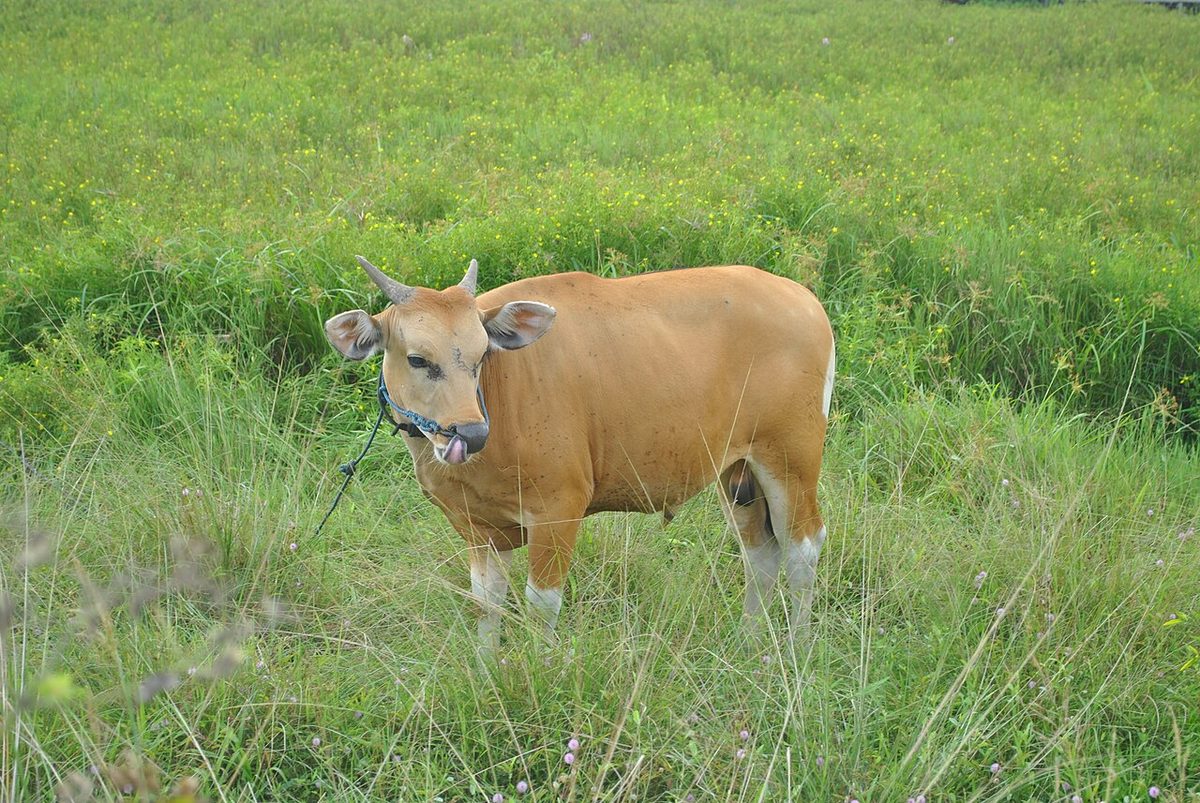
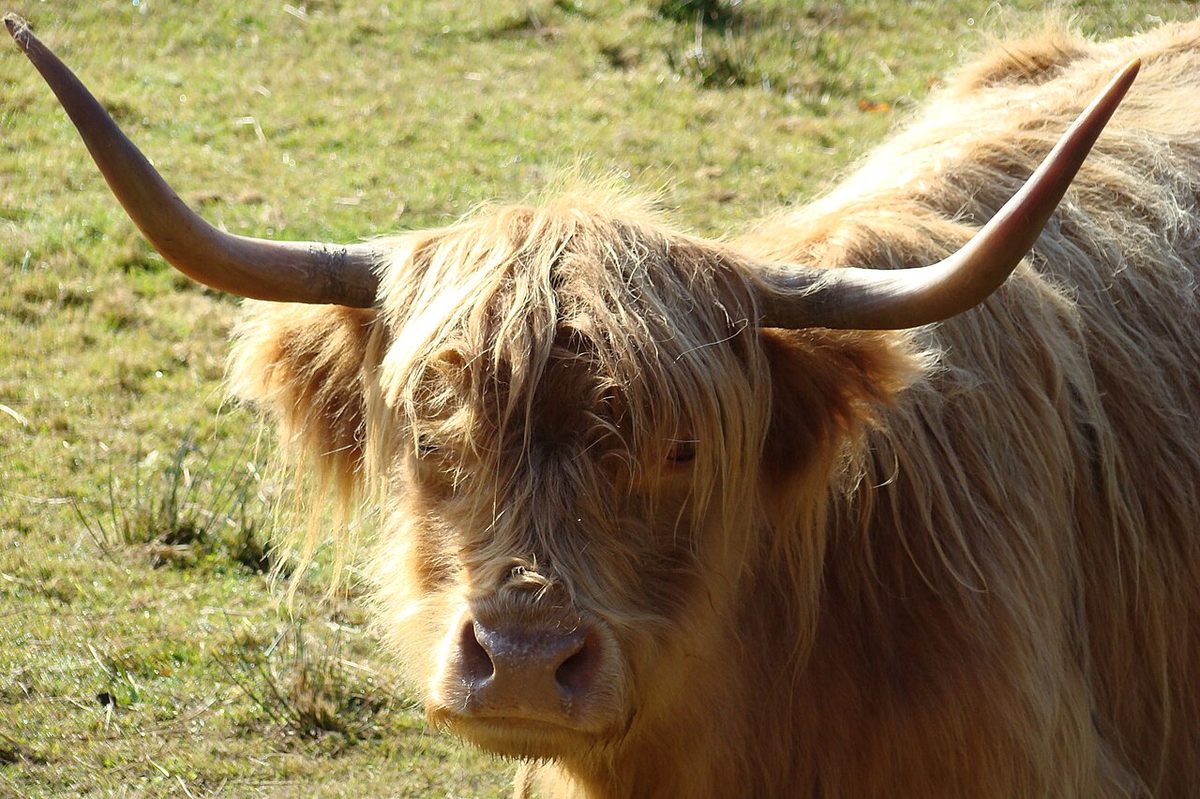
If you picture a long-horned cow standing in the rain, you are almost certainly picturing a Highland. It is the world's best-known long-horned breed: a Scottish animal with sweeping horns, a shaggy double coat, and a name for shrugging off weather that would send most cattle looking for shelter.
Below is what the documented record actually says about the breed — where it came from, how big it grows, the colours it comes in, how many are left and what it might be worth. Where the numbers run out, that is said plainly too, so you never mistake one figure for another.
Where the Highland comes from
The Highland is a Scottish breed, known in Scottish Gaelic as Bò Ghàidhealach and in Scots as Hieland Kye. It originated in the Scottish Highlands and the Western Islands of Scotland. It is described as a hardy or "rustic" breed — one able to withstand the intemperate conditions of that region. It is reared primarily for beef, and it has been exported to several other countries.
Today's Highland is really two older types rolled into one:
- The Kyloe — reared mainly in the Hebrides, or Western Islands. It was small and frequently black, and it took its name from the practice of swimming the cattle across the narrow straits, or kyles, that separate the islands from the mainland.
- Mainland cattle — somewhat larger and very variable in colour, often brown or red.
A breed society was established in 1884. It published the first herd-book volume in 1885, and that volume recorded both types without distinction, under the single name "Highland". From that point on, island cattle and mainland cattle were one breed on paper.
The horns and the remarkable coat
Long horns are the breed's signature, and they appear on both bulls and cows. One honest note before you go looking for a measurement: the documented record here describes Highland horns as long, but it does not put a number on them. Horn length is not given, so any specific centimetre figure you see elsewhere is not something this profile can confirm.
The coat is where the Highland really separates itself from other cattle. It carries an unusual double coat:
- An oily outer hair — the longest of any cattle breed — which sheds rain and wind.
- A downy undercoat underneath, which holds warmth.
That combination is tied directly to the Highland homeland, where annual rainfall is high and the winds are sometimes very strong. In other words, the coat is not decoration. It is the reason the breed is called hardy in the first place.
What colour will your Highland be?
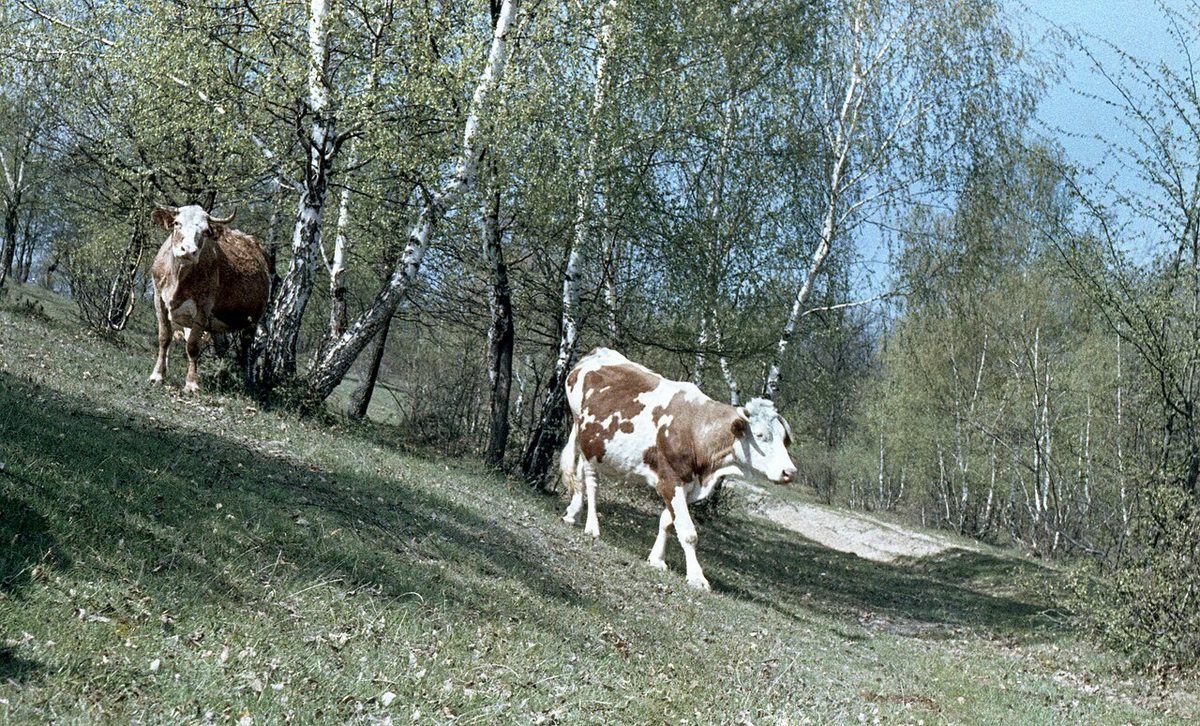
Coat colour is mostly reddish brown, with yellow the second most common shade. The breakdown looks like this:
- Reddish brown — the usual colour, seen in approximately 60% of the population.
- Yellow — some 22%.
- Pale silver, black or brindle/dun — the remainder.
These colours come from alleles at the MC1R gene (the E locus) and the PMEL or SILV gene (the D locus). In practice, that means colour is inherited in a fairly predictable way rather than being random — useful to know if you are breeding for a particular look.
How big does a Highland get?
Highlands are not tall cattle, but they are heavier than they look, because so much of the frame sits under that coat. The recorded figures are:
- Mature bulls can weigh up to 800 kg (1800 lb).
- Heifers can weigh up to 500 kg (1100 lb).
- Cows typically stand 90–106 cm (35–42 in) tall.
- Bulls typically stand 106–120 cm (42–47 in) tall.
So the breed is short-legged and deep-bodied. That low, sturdy build is part of what lets it graze rough ground and hold condition in poor weather.
Breeding and calving
Mating occurs throughout the year rather than in a tight seasonal window, and the gestation period is approximately 277–290 days. If you are planning a calving date, work back from that range. Note that this profile cannot tell you how many calves a Highland typically delivers per birth — that detail is not covered here.
A beef breed, plainly
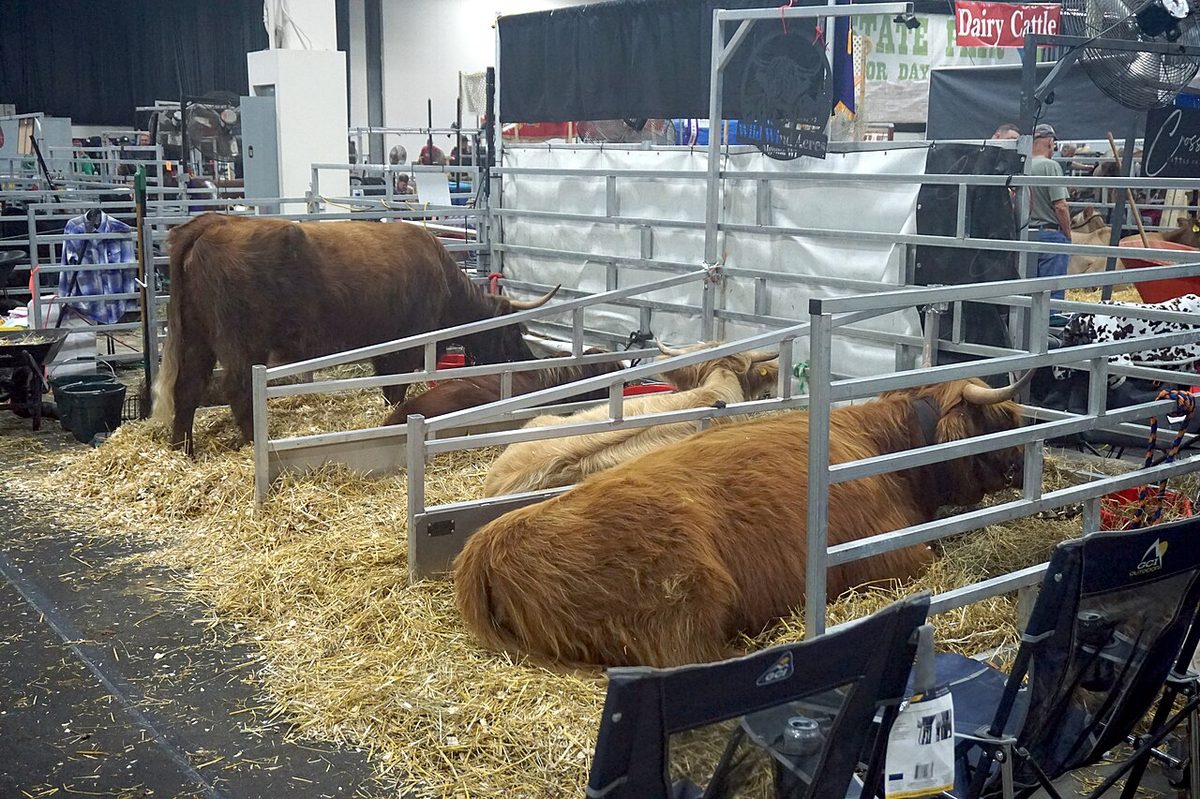
The documented position is simple: the Highland is reared primarily for beef. It is not described as a dairy breed in this material, and no milk yield figures are given.
It is worth being equally blunt about what is not covered. There are no carcass weights, no beef quality or eating-quality scores, and no premium-price information for Highland beef in this profile. If you have heard that Highland beef fetches more, that may well be true where you farm — but this article cannot put a number on it. Ask your local butcher, mart or breed society for the prices actually paid in your area.
From the Scottish Highlands to the world
These cattle mattered to the Scottish economy long before anyone called them a heritage breed. At markets such as Falkirk and Crieff, drovers from England bought stock and moved it south over the Pennines to be fattened for slaughter. In 1723 alone, over 30000 Scottish cattle were sold into England.
Exports of the breed itself began in the late nineteenth century. Stock went to Argentina, Australia, Canada, the Falkland Islands, the former Soviet Union and the United States, among others. Later in the twentieth century there were further exports to various European countries. In 1954 Queen Elizabeth II decided to keep a herd of Highland cattle at Balmoral Castle, where they are still kept today.
Country by country
- Canada — first imported in the 1880s. The Hon. Donald A. Smith (later Lord Strathcona) and Robert Campbell each imported one bull to Manitoba, and there were also Highland cattle in Nova Scotia in the 1880s. Numbers stayed small until the 1920s, when large-scale breeding and importing began; in the 1950s cattle were imported from and exported to North America. The Canadian Highland Cattle Society was officially registered in 1964. Towards the end of the 1990s there was a large semen and embryo trade between the UK and Canada, which has stopped — largely because of the BSE (mad cow disease) outbreaks in the United Kingdom.
- United States — the American Highland Cattle Association was first organised in 1948 as the American Scotch Highland Breeders Association, and it now claims approximately 1100 members.
- Australia — Scottish immigrants brought small numbers from the mid-nineteenth century, but by the late 1800s none remained. Re-establishment began with an import of two cows and a bull from Scotland in 1954. Stock was later increased mostly by breeding up using imported semen, with some use of embryo transfer. The Australian Highland Cattle Society was formed in 1988.
- Finland — Finnish studbooks show importation of Highland breeding stock dating back to 1884. The Finnish club reports that in 2016 there were 13000 Highland cattle in the country.
- Sweden — the Swedish Highland Cattle Club was founded in 1976. Borlänge Municipality in Dalarna keeps a herd of 105 Highland cattle for conservation grazing; the project began in 1994 when five cattle were bought to graze restored shoreland meadows at Vassjön, a lake being restored as a wildlife habitat.
- Denmark — has its own Danish Highland Cattle Society.
That Swedish example is a useful way to think about the breed's second job. Beyond beef, Highlands are used for conservation grazing — keeping open landscapes open on ground that would be awkward or uneconomic for other cattle.
How many Highland cattle are there?
This is where the picture gets interesting, and a little uneven. In 2022 the breed was reported to DAD-IS by twenty-three countries, of which seventeen reported population data. The total population world-wide was reported at just over 40000, with the largest numbers in France and Finland.
Registered breeding cows in the United Kingdom, meanwhile, have moved up and down:
- 2002 — about 2500 registered breeding cows.
- 2012 — some 6000.
- 2021 — 3161.
In 2001 the population for Canada and the United States combined was estimated at 10000.
Two things are worth holding together here. First, the breed's conservation status in the United Kingdom is listed in DAD-IS as endangered/at risk, based on those 3161 registered breeding cows in 2021. Second, the number of unregistered cattle is not known — so the true UK picture is larger than the registered figure, by how much is anybody's guess.
And a word on geography: outside France, Finland, the United Kingdom, Canada, the United States and Sweden, this profile does not say which of the reporting countries hold how many animals. If you want a national figure for your own country, your breed society or agriculture office is the place to ask.
What might a Highland be worth?
This is the part where you need to be careful, because the price data we hold is not breed-specific.
Our own recorded figures cover 1969 heifer price observations. In that set:
- Lowest recorded value: €2 per kg
- Highest recorded value: €10 per kg
- Average recorded value: €6 per kg
- Most recent record dated: 2026-11-01
These heifer rows sit inside our wider price database of 267986 rows (sample and manually entered rows excluded), which is fed by faostat and is mostly crops quoted in ₹ per kg — wheat at ₹16–₹50, potato at ₹1–₹45, onion at ₹6–₹120, and so on. The heifer lines are the only livestock prices in that table, and they are quoted in € per kg while the crops are quoted in ₹ per kg. The two currencies sit side by side, and nothing in the data explains the difference or offers a conversion.
So here is the honest reading: those heifer figures are a general heifer market signal, not a Highland price. They are not broken down by breed, and they tell you nothing about what a registered Highland cow, a weanling or a breeding bull would make at your local mart. There is also no purchase price, registration fee or semen or embryo cost given here, even though the trade in semen and embryos is mentioned in the Canadian story.
For a real number, talk to a local dealer, your nearest livestock market, or your national breed society. Prices move by country, season and animal, and no single figure will serve you well.
A "fold", not a herd
One small piece of the breed's character worth knowing: although a group of cattle is generally called a herd, a group of Highland cattle is known as a fold. The word comes from the old practice of keeping the cattle overnight in open stone shelters called folds, to protect them from the weather. It is a good reminder of how the breed was traditionally managed — outdoors, in rough country, with only a stone wall for shelter.
What this profile cannot tell you
Some questions matter a lot when you are deciding whether to keep a breed, and this material simply does not answer them. Rather than guess, here is the list:
- Horn measurements. The horns are described as long, but never quantified.
- Other long-horned breeds. This profile covers the Highland only, so no comparison with Texas Longhorn, Ankole, zebu or any other long-horned cattle is possible from this material.
- Husbandry. There is nothing here on feeding, winter housing, fencing, calving assistance, or handling and safety around those horns.
- Performance outside cool, wet climates. The breed's hardiness is tied to Highland conditions of high rainfall and strong winds. How it fares in heat or dry country is not addressed.
- Beef economics. No carcass weights, no quality grading, no premium pricing.
On all of those, the answer genuinely depends on your local situation — your climate, your ground, your market and your regulations. A nearby vet, livestock dealer or agriculture office can fill in what this profile cannot. Do not build a business plan on a figure you cannot trace.
The bottom line
The Highland earns its place as the world's best-known long-horned breed for good reason. It is a genuine piece of Scottish history, with island and mainland roots, a herd book going back to 1885, and exports that carried it to Argentina, Australia, Canada, the United States, the Falklands and across Europe.
It is a small-framed but heavy beef animal — bulls up to 800 kg (1800 lb), cows standing 90–106 cm (35–42 in) — wrapped in the longest outer coat of any cattle breed and a downy undercoat beneath it. It comes mostly in reddish brown, with yellow a clear second. And it is still doing useful work, from Balmoral Castle to the shoreland meadows at Vassjön in Sweden.
The numbers also carry a warning. With 3161 registered breeding cows in the UK in 2021 and a UK status of endangered/at risk, the breed's future rests on breeders who register and keep records. If you are thinking of keeping Highlands, start with your local breed society, and ask them the price, husbandry and horn-handling questions this article has honestly left open. You can also browse more breeds in our A–Z index of animals.
 Menu
💬 Comments
Login to comment
No comments yet. Be the first to share your experience!