🍪 Cookie Consent
We use cookies to improve your experience, analyse how the site is used, and show relevant content. By choosing Accept you agree to that. See our
Privacy Policy.
A Farmer's Guide to Keeping Pet Dogs and Cats Healthy at Home
Research covers dog biology and commodity prices — but surprisingly little practical guidance on home pet care. This guide fills the gap with honest, actionable advice and a clear note on what to check locally with your vet.
Keeping your pet dog or cat healthy at home starts with three reliable foundations: good nutrition, clean living conditions, and regular veterinary attention — yet the available research on this topic is surprisingly thin. Most published sources focus on dog biology and global commodity prices rather than practical home healthcare guidance. That means what follows is an honest synthesis of what the research does and does not tell us, along with our own price observations from 180,330 marketplace records to help you understand the cost side of pet ownership.
A Very Old Partnership
Cori Copely (hotel dog of the Fairmont Copley Plaza Hotel) GK9 yj5WwAAsdud by Massachusetts State Police (Public domain) · source
Dogs are the oldest domesticated animal on earth. They were domesticated over 14,000 years ago by hunter-gatherers during the Late Pleistocene — long before the development of agriculture. The earliest conclusively identified domesticated dog remains come from Bonn-Oberkassel and are dated to 14,223 years ago. Some genetic studies suggest the process may have begun even earlier, over 25,000 years ago.
This long history matters for your daily life with a dog. Thousands of years of close association with humans have shaped dogs in ways that set them apart from their wild relatives. One of the clearest examples is digestion: dogs uniquely possess the ability to thrive on a starch-rich diet — something wolves and other canids cannot do. This adaptation reflects exactly those thousands of years of living alongside people who ate grain-based foods. It is a reminder that dogs are not wolves, and their nutritional needs reflect their domesticated heritage.
Cute Cat with Beautiful Green Eyes by epSos.de (CC BY 2.0) · source
What the Research Actually Covers — and What It Does Not
Example of classical conditioning by Yohan euan o4 (CC BY-SA 3.0) · source
Before going further, it is worth being clear about the limits of what the available sources say. The research we found covers:
Dog biology, evolution, and taxonomy
Global dog population figures
Dog communication and behavior
Commodity price data across multiple countries and currencies
Dingo classification debates in Australia
The research does not cover practical home healthcare for either dogs or cats. There is no guidance on diet formulations, vaccination schedules, grooming routines, safe household environments, exercise plans, common diseases and their symptoms, or toxic foods. On cats specifically, none of the sources mention cats at all. For all of those topics, you will need to consult a local veterinarian, an agricultural extension office, or a trusted regional animal health guide, as advice varies significantly depending on your country, climate, local breeds, and the specific animal in your care.
What the Sources Do Tell Us About Dogs
DSC09611a Search and Rescue Dog, Austrian Red Cross Perchtoldsdorf, 2024-10 by Aciarium (CC BY 4.0) · source
Understanding your dog's biology can help you make better everyday decisions — even without a veterinary manual in front of you. Here is what the research confirms.
Population and Place
Alaminos,Lagunajf0931 08 by Ramon FVelasquez (CC BY-SA 3.0) · source
The global dog population is estimated at 700 million to 1 billion. About 20% of these dogs live in developed countries, while around 75% are in developing countries, where they are mostly feral or street dogs. In the United States specifically, dogs are the most popular pet, found in 34–40% of households. This wide variation in living conditions is important context: the health needs of a companion dog in a home are very different from those of a street dog, and resources and veterinary access also vary dramatically between countries.
Physical Makeup
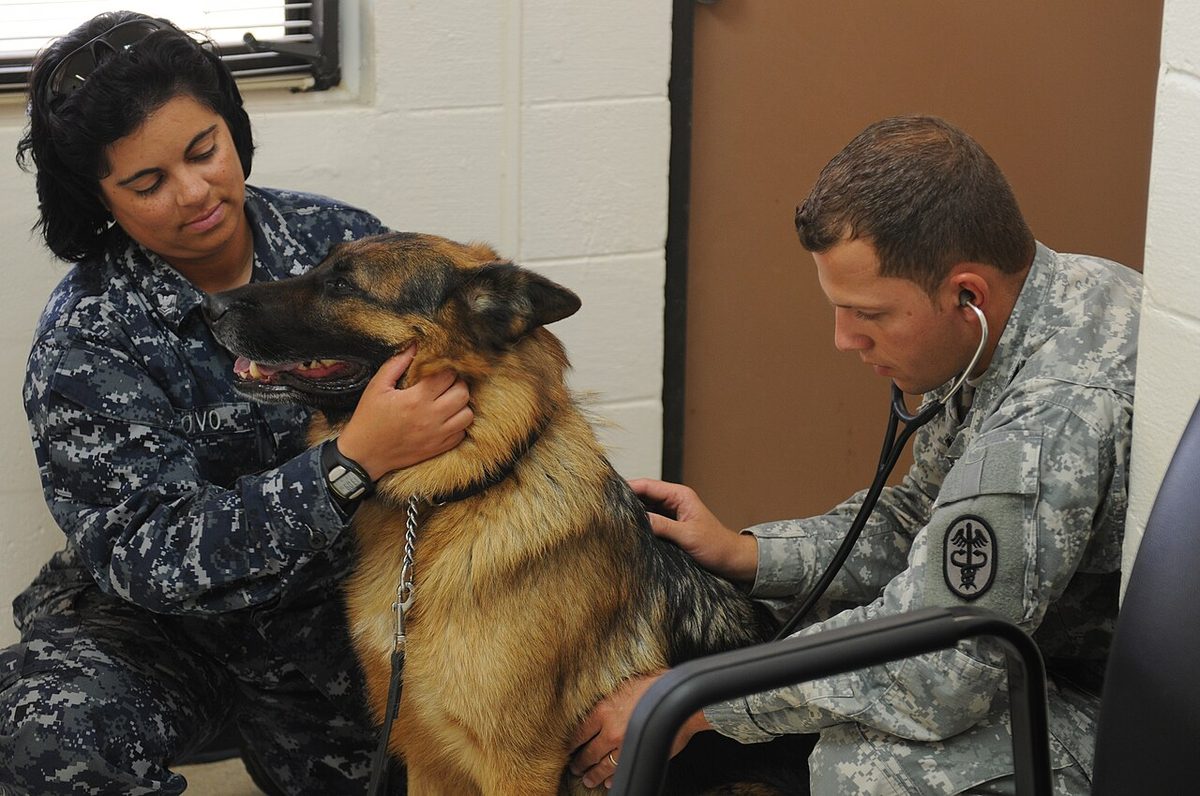
Big dog gets a veterinary exam at Guantanamo -c by Maddelin Angebrand (Public domain) · source
Dogs have powerful jaws containing around 42 teeth. Their senses of smell and hearing are superior to those of humans, though their visual acuity is inferior. They share the same number of bones as wolves, with the exception of the tail. These physical traits shape how dogs experience their environment and how they interact with the world around them — a dog that seems distracted on a walk is often simply processing far more smell-information than a person can imagine.
How Dogs Communicate With You
Human–canine friendship - girl hugging her dog tightly at golden hour in Laos by Basile Morin (CC BY-SA 4.0) · source
Dogs communicate through eye gaze, facial expression, vocalization, body posture, and chemical communication via scents and pheromones. They mark territory by urinating, especially in new environments. Over millennia, they have uniquely adapted to understand human communication in ways that no other canid has. Learning to read your dog's body language — tail position, ear position, the way they hold their head — is one of the most practical skills a pet owner can develop. It costs nothing and it can help you notice changes in mood or health long before a problem becomes serious.
What You Feed Matters — and So Does What It Costs
Do not feed the dog by Bryan Ledgard (CC BY 2.0) · source
Because the sources do not give specific feeding guidelines for pet dogs, we need to be careful here. The research confirms that dogs can digest starch-rich diets — an ability they developed through domestication — but it does not specify portion sizes, ingredient ratios, or which commercial or homemade diets are safest. Those questions depend on your dog's breed, age, size, activity level, and local climate. Talk to a vet who knows your animal.
What we can share, however, is our own price data. The following commodity prices — drawn from 180,330 price observations across all countries, most recently recorded on 24 September 2026 — reflect what staple ingredients cost in global markets right now. These are the raw materials behind many commercial pet foods, and understanding their market values can help you gauge whether pet food prices in your area seem reasonable.
Commodity
Unit
Low
Average
High
Observations
Wheat
₹/kg
16
26
48
2,380
Wheat Dara
₹/kg
22
25
36
2,187
Wheat FAQ
₹/kg
20
26
42
1,694
Wheat Mill Quality
₹/kg
21
26
46
1,238
Soyabean
₹/kg
15
56
110
1,376
Green chilli
₹/kg
7
40
245
2,063
Heifers
€/kg
2
6
10
2,202
Cows
€/kg
2
5
8
2,094
Young bulls
€/kg
2
6
9
1,758
Soyabean averages ₹56 per kg, the highest among the listed food commodities, with a range from ₹15 to ₹110/kg. Green chilli shows the widest price spread at ₹7 to ₹245 per kg. Wheat prices are more stable, averaging ₹26/kg across all grades. Livestock prices are recorded separately in euros, with heifers and young bulls both averaging €6/kg and cows averaging €5/kg, based on data from 20 September 2026.
These figures are from our own recorded data, sourced from FAOSTAT. They are not pet food prices — they are global commodity prices — but they give you a real-time picture of what the underlying ingredients cost in the market. If you are making homemade feeds or assessing whether commercial prices are fair, this is where the information comes from. Prices for region-specific items like bhindi (ladies finger) and kheera (cucumber) are also tracked, reflecting the marketplace's strong presence in India. Currency denominations — Indian Rupees for crop commodities and Euros for livestock — are a reminder that pet food costs and availability vary by country. Check with local dealers for current prices in your area.
When Classification Affects Real Life
Most pet owners will never need to think about animal taxonomy, but for farmers and residents in certain parts of the world, how a dog-related animal is classified directly affects legal rights, land management, and daily safety.
Dingo classification in Australia is one of the best examples. Scientists and policymakers disagree on how to classify dingoes. They have been considered a subspecies of dog, a sibling subspecies of wolf, or their own species entirely. A 2019 IUCN/SSC Canid Specialist Group workshop classified dingoes as feral Canis familiaris, meaning they were not assessed separately for the IUCN Red List.
This is not an academic argument. Classifying dingoes as wild dogs makes population control simpler for livestock protection. Treating them as a separate species enables conservation programs. The classification chosen by your government affects wildlife management policies, legislation, and societal attitudes — so it is worth understanding which classification applies in your country and what rights and responsibilities follow from it.
The same kind of debate exists around dog species taxonomy more broadly. Linnaeus classified the domestic dog as Canis familiaris in 1758, while later taxonomists have proposed Canis lupus familiaris, treating the dog as a subspecies of wolf. Both names appear in scientific literature. The point for pet owners is simply this: the scientific labels do not change how you care for your dog, but they do reflect the deep evolutionary connection between domestic dogs and wild canids.
What This Means for You Every Day
The honest truth from the available research is that keeping any pet healthy at home requires local knowledge that these global sources simply do not provide. No source here tells you which vaccines to give your dog, how often, or at what age. No source lists the signs of common illness. No source advises on safe foods, safe household chemicals, appropriate exercise for different breeds, or how to choose a breed suited to your climate and farm.
Here is what you can reliably do with the information that does exist:
Use the starch-digestion fact to have an informed conversation with your vet about whether grain-inclusive or grain-free diets suit your dog's biology — dogs are different from wolves in this respect.
Use the commodity price tables to gauge whether pet food prices in your local market are in line with global trends for key ingredients like wheat and soyabean.
Watch your dog's body language, since communication through gaze, posture, and vocalization is how your dog tells you how they feel.
Check local regulations if you live in a region where dingo or wild dog classification affects what you can do on your land.
Consult a local vet for everything else — breed-specific advice, vaccination schedules, parasite control, and environmental care all depend on where you live and what your individual animal needs.
Know the Warning Signs That Need a Vet Right Away
Some problems cannot wait. Get your animal to a vet immediately if you see any of these:
Struggling to breathe, or breathing very fast for no obvious reason
Vomiting or diarrhoea that lasts more than a day
Limping, refusing to walk, or crying out in pain
Swollen belly, which can mean bloat — a life-threatening emergency in dogs
Sudden changes in thirst, appetite, or energy levels
Seizures, confusion, or collapse
When in doubt, call your vet. It is always better to check early than to wait and hope.
Build a Simple First-Aid Kit for Your Animals
Every farm should keep a small kit ready for pets. Here is what to include:
Gauze pads and bandages
Antiseptic solution safe for animals
Tweezers for thorns, ticks, or splinters
Digital thermometer
Your vet's phone number — saved in your phone and written on paper
Knowing basic first aid can save your pet's life before the vet arrives.
A Final Word
Keeping dogs and cats healthy on a farm does not require expensive equipment or fancy routines. It comes down to three things: good food, clean water, regular check-ups, and plenty of love and attention from the people around them. Your animals are part of the farm family. Treat them well, watch for changes, and do not hesitate to call a professional when you need one. A healthy pet is a happy companion for years to come.
❓ Frequently asked questions
How many dogs are there in the world?
The global dog population is estimated at between 700 million and 1 billion. Around 75% of these dogs live in developing countries, mainly as feral and street dogs, while developed countries are home to approximately 20%.
Can dogs eat the same food as humans?
Due to thousands of years of living alongside humans, dogs have uniquely adapted to thrive on a starch-rich diet — something that would be inadequate for wolves and other canids. This ability sets them apart from most other members of the dog family.
How long have dogs lived with humans?
Dogs were first domesticated at least 14,000 years ago by hunter-gatherers, before the development of agriculture. The earliest conclusively identified remains, known as the Bonn-Oberkassel dog, date back 14,223 years. Genetic studies suggest domestication may have begun over 25,000 years ago.
How well do dogs see compared to humans?
Compared with humans, dogs have a superior sense of smell and hearing but weaker visual acuity. They have around 42 teeth and share the same number of bones as wolves, with the tail being the main exception.
What do commodity prices look like for pet food ingredients?
The marketplace records 180,330 price observations across all countries sourced from FAOSTAT. As of late September 2026, wheat averages ₹26 per kg (ranging from ₹16 to ₹48), soyabean averages ₹56 per kg (₹15 to ₹110), and green chilli ranges widely from ₹7 to ₹245 per kg. European livestock prices include heifers averaging €6 per kg and cows averaging €5 per kg.
Why does dingo classification matter in Australia?
Classifying dingoes as wild dogs makes population control simpler for livestock protection, while treating them as a separate species supports conservation programs. This classification affects wildlife management policies, legislation, and societal attitudes across Australia.
📚 Where the figures in this guide come from
We read what has already been published on the subject, take out the figures and rules it actually states, and write it up in plain, everyday language.
Every number and name here traces back to a source listed below — nothing in this guide is invented.
Our own records
Price observations recorded by this site (worldwide)
Prices, rules and animal health advice change and vary by area. Check anything important with a local vet, dealer or agriculture office before you spend money.
Spotted a mistake? Tell us in the comments and we will correct it.












 Menu
Menu
💬 Comments
Login to comment
No comments yet. Be the first to share your experience!