
If you want the short answer: no one can give you a fixed list of animals that goats always get along with, because the outcome depends on your own land, your housing, your water points, your feed and the diseases that circulate where you live. What is genuinely well documented is that wild goats do share large landscapes with a wide mix of other animals — but sharing ground is not the same as being penned, fed or grazed together, and only a vet or an experienced keeper near you can tell you what will work on your holding.
That may not be the tidy answer you were hoping for, so here is what this post does instead. It sets out what is solidly known about goats sharing ground with other species, it is honest about the parts that vary from place to place, and it gives you the exact questions to put to someone local before you mix stock.
Why there is no universal "goats go with X" list
Plenty of pages will confidently pair goats off with horses, pigs, rabbits, poultry and everything in between. Those lists read nicely. The trouble is that the things which actually decide whether a mix works are all local.
What changes the answer on your place includes:
- How much land you have, and what it grows
- Your housing, and whether animals share a shed, a trough or a water point
- The feeds and minerals you use, and which species can reach them
- The diseases and parasites that are already around you
- Your local rules on keeping and moving several species on one holding
All of those differ between countries, and often between one valley and the next. So questions like whether it is fine to keep a single goat, whether goats can share a shed with sheep or cattle, and how many head your grazing will carry are genuinely local questions. Ask a nearby vet, a livestock dealer you trust, or your local agriculture office. Anyone who gives you one number for the whole world is guessing.
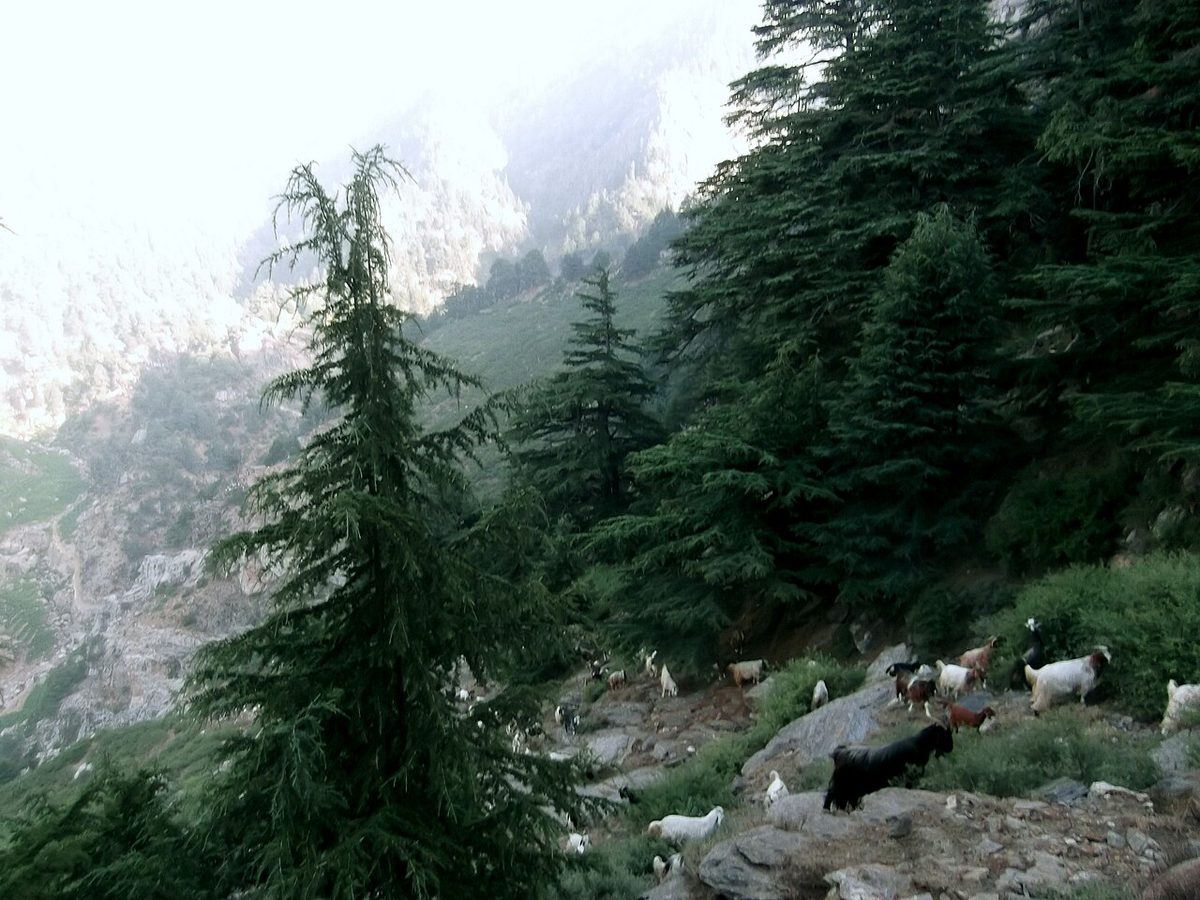
What we do know: mountain goats in a shared landscape
There is one clear, real example of goats living among other species on a big scale. Custer State Park sits in the Black Hills of Custer County, South Dakota, in the United States, and you can reach it by road from Rapid City. It is South Dakota's first and largest state park, covering over 71,000 acres (287 km2) of rolling prairie grasslands and rugged mountains, after 22,900 acres (93 km2) were added in 1964.
Mountain goats are listed among the animals that live there. Their neighbours include:
- A herd of 1,400 bison
- Elk, mule deer and white-tailed deer
- Bighorn sheep and pronghorn
- Prairie dogs and river otters
- Feral burros
- Coyotes, bobcats and cougars
What that tells you, and what it does not
It tells you that goats can share a wide landscape with large grazers, small mammals and predators, and that all of those animals can be present in the same reserve at the same time.
It does not tell you that they are grazed together, penned together or fed together. Nothing in that record describes any two of those species as compatible with each other. And it is worth noticing that coyotes, bobcats and cougars are on the same list — a good reminder that "the same ground" is not the same thing as "safe together". Farmed goats kept alongside farmed stock are a different question again, and one you should settle locally.
The clearest meaning of "compatible": animals matched to the forage
Here is something useful. In grazing management, "compatible" is often used about numbers rather than species. At Custer State Park, several hundred bison are sold at a yearly auction in September so that the remaining number of animals will be compatible with the rangeland forage. In other words, the herd is matched to the grass, not to the other animals.
That system exists because of what happened without it. By the early 1940s the herd had grown to 2,500 bison, and the park had to build a management approach to keep the animals healthy and stop the native grasses being overgrazed. Today the herd stands at 1,400 bison, with 400 to 500 calves born each year on that same open ground.
How one big mixed reserve handles it in practice
The gather happens once a year, in the fall. Riders bring the herd in to check animal health, vaccinate calves, collect data and pick out animals for removal. The examinations include biological information such as height, weight and pregnancy checks, and calves are branded and vaccinated. It takes 50 to 60 riders to move the animals along a five-mile trail (8.0 km). The official round-up began in 1965 and now draws crowds of 16,000 to 20,000 people who come just to watch.
Selling surplus animals is treated as a normal tool, not a failure. The herd began with thirty-six bison bought in 1914, one of the earliest public efforts to preserve the species. Surplus animals were sold or transferred to ranchers, parks and conservation programmes around the country, and became the foundation for many modern bison herds across the USA. The genetics of round-up animals can also be used to improve the health of other herds.
None of that is goat-specific, and there is no per-goat, per-acre or per-hectare stocking figure I can honestly hand you. But the principle travels: count your animals against the feed your land actually grows, watch the ground, and take numbers off before the grass suffers.
Wild deer, prion disease and shared ground
If deer come onto your land, you may have heard about chronic wasting disease, or CWD. Here is the careful version. CWD prions are transmissible within the deer family, Cervidae, and the disease has not been confirmed as transmissible to humans or livestock. Transmission to other species, such as squirrel monkeys and humanized mice, has been seen only in experimental settings. In the United States it affects mule deer, white-tailed deer, red deer, sika deer, elk, caribou and moose.
Goats are not named at all in that picture. So there is no basis for telling you either that your goats are at risk from wild deer, or that they are safe. If you graze where infected deer are present, that is a conversation for your vet and your local animal health office.
CWD belongs to a group called transmissible spongiform encephalopathies, alongside mad cow disease in cattle, Creutzfeldt–Jakob disease in humans, and scrapie in sheep. No goat prion disease is named in that group.
Where it has turned up
- First identified in 1967 in mule deer at a government research facility in northern Colorado, and identified specifically as a TSE in 1978
- Found in free-ranging and captive populations in 33 US states and five Canadian provinces, plus one Minnesota red deer farm
- One wild reindeer herd in Norway, in March 2016
- Wild moose, with single cases in Finland in March 2018 and in Sweden in March and May 2019 and September 2020
- South Korea, in some deer imported from Canada
Why it is hard to clear from ground
The prion is stubborn. It is insoluble in all but the strongest solvents and highly resistant to digestion by proteases. How long the CWD prion lasts in the environment is unknown, but the scrapie prion has been measured to endure for 16 years. The way it spreads inside an animal is by conversion: the abnormal protein turns normal protein into more of itself on contact and binds into clumps, and it was noted in 2001 that once that formation starts, the protein increases exponentially. Researchers writing in July 2019 concluded that the sensible response is to reduce the potential sources of exposure.
Most infected deer also drink and urinate more, and that increased drinking and salivation may itself help the disease spread. So shared water is worth thinking about where deer and stock use the same source, even though nothing here settles the question for goats.
What a wasting animal looks like
These signs are recorded for deer, not goats, so treat them as a general picture of what a slow wasting illness looks like rather than a diagnosis. Onset comes 18 to 24 months after exposure, so most cases are adults; the youngest animal to show clinical signs was 15 months. The disease is progressive and always fatal.
- First signs are difficulties in movement
- The most obvious and consistent sign is weight loss over time
- Behavioural changes in most cases: less interaction with other animals, listlessness, a lowered head, tremors, walking the same pattern over and over, nervousness, heavy salivation, teeth grinding, more drinking and urination, loss of fear of people, confusion
- Summarised officially as behavioural changes, emaciation, weakness, ataxia, salivation, aspiration pneumonia and progressive death
An animal pulling away from the rest of the group and losing condition steadily is always worth a vet's eyes, whatever the cause turns out to be.
What the market numbers show, and where they stop
If you are deciding what to keep beside your goats, price matters. Our own worldwide price observations hold 71,352 rows across all countries, drawn from faostat, with sample and manually entered rows excluded. The commodities recorded include heifers, cows, young bulls, young cattle, steers, cow milk, hen eggs, chicken meat, sheep meat, cattle meat, pig meat and pig carcass. There is no goat line and no goat-milk line at all.
The nearest comparisons we can show you:
- Sheep meat: EUR562 lowest to EUR29682 highest, average EUR3160 per tonne, from 558 rows, most recent 2025-01-31
- Cattle meat: EUR988 to EUR20740, average EUR2728 per tonne, most recent 2025-01-31
- Live heifers: €2 to €10, average €6 per kg, from 2,213 rows, most recent 2026-08-30
- Cows: €2 to €8, average €5 per kg, most recent 2026-08-30
- Pig carcass: €1 to €3, average €2 per kg, most recent 2026-08-30
Feed costs are patchier. Feed barley, breadmaking common wheat, feed wheat and feed maize all come through rounded to €0 lowest, €0 highest and €0 average per kg, most recent 2026-08-30, which makes them useless for costing a ration. Usable grain figures only appear in other currencies: white maize at XOF63 lowest, XOF383 highest and XOF161 average per kg, most recent 2026-07-15, and wheat at ₹22 lowest, ₹35 highest and ₹26 average per kg, most recent 2026-09-03. No forage, browse or mineral supplement prices are recorded.
So for what a goat, goat meat or goat milk is worth where you are, your local market, dealer or auction is the only reliable source. Prices for these things swing hard by season and country.
Your local checklist before you mix stock
Take this list to a vet, an experienced neighbour or your nearest agriculture office. These are the points that decide whether a mixed setup works, and every one of them is local:
- Do your goats need company, and is keeping one goat alone acceptable where you are?
- Which species can share your grazing and your housing — sheep, cattle, horses, donkeys, pigs, poultry, camelids?
- Are the feeds and minerals you give goats safe for every other animal that can reach the same trough?
- Which diseases and parasites do your species share, and does mixed grazing raise or lower the worm burden on your ground?
- What protects your goats from local predators, and what do keepers near you actually use?
- How many goats will your land carry, alone or in a mixed rotation?
- What fencing and shelter do you need when goats share ground with much bigger or much smaller animals?
- How should you introduce new goats, and manage bullying, hierarchy, bucks, does and wethers?
- What movement records and holding rules apply when you keep several species on one place?
Write down the answers you are given and who gave them. That local record will serve you far better than any global list.
The bottom line
Goats are compatible with the setup you can actually manage: enough feed for the numbers you keep, housing and troughs that suit every species using them, and a health plan built for the diseases that exist around you. The one hard example we have is wild mountain goats living across more than 71,000 acres (287 km2) of prairie and mountain alongside bison, deer, bighorn sheep and predators — proof that goats can share a landscape, not proof that any two species belong in the same pen. And the clearest working meaning of "compatible" in grazing is animals matched to forage, the same thinking that keeps a 1,400-strong bison herd healthy on that range. Get the numbers and the local advice right, and the species question becomes much easier to answer for your own farm.
Last updated: 4 September 2026.
 Menu
Menu
💬 Comments
Login to comment
No comments yet. Be the first to share your experience!