🍪 Cookie Consent
We use cookies to improve your experience, analyse how the site is used, and show relevant content. By choosing Accept you agree to that. See our
Privacy Policy.
Chicken Breeds with Rose Combs: 4 Popular Examples
Rose combs are more than a pretty feature — they help chickens resist frostbite and belong to some of the world's most loved breeds. Here is a friendly look at the Dominique, Leghorn, Wyandotte, and one notable cousin that does not carry the trait.
Four breeds most commonly associated with rose combs are the Dominique, the Leghorn, the Wyandotte, and — though it does not actually carry a rose comb — the Chantecler, which is worth knowing about if you are looking for cold-hardy layers. Each breed has its own history, its own egg and meat characteristics, and its own conservation story. Which one suits your farm depends on your climate, your goals, and whether you value heritage genetics.
Single Comb
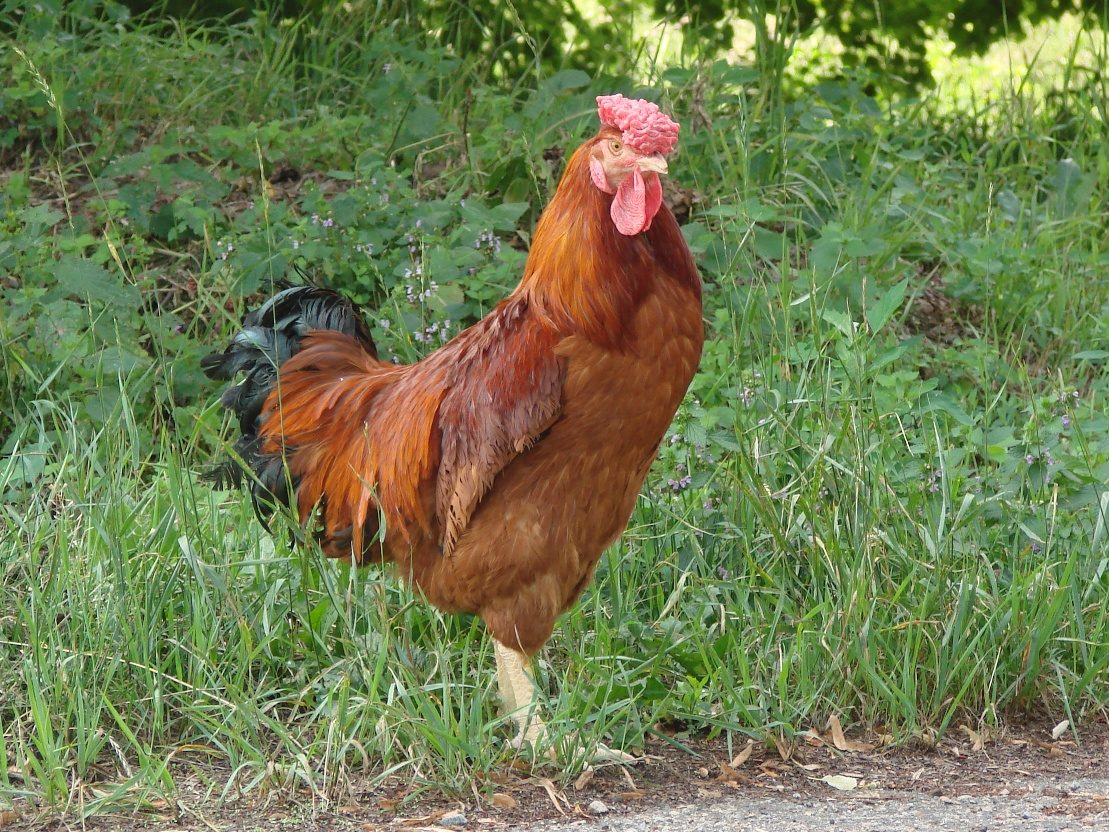
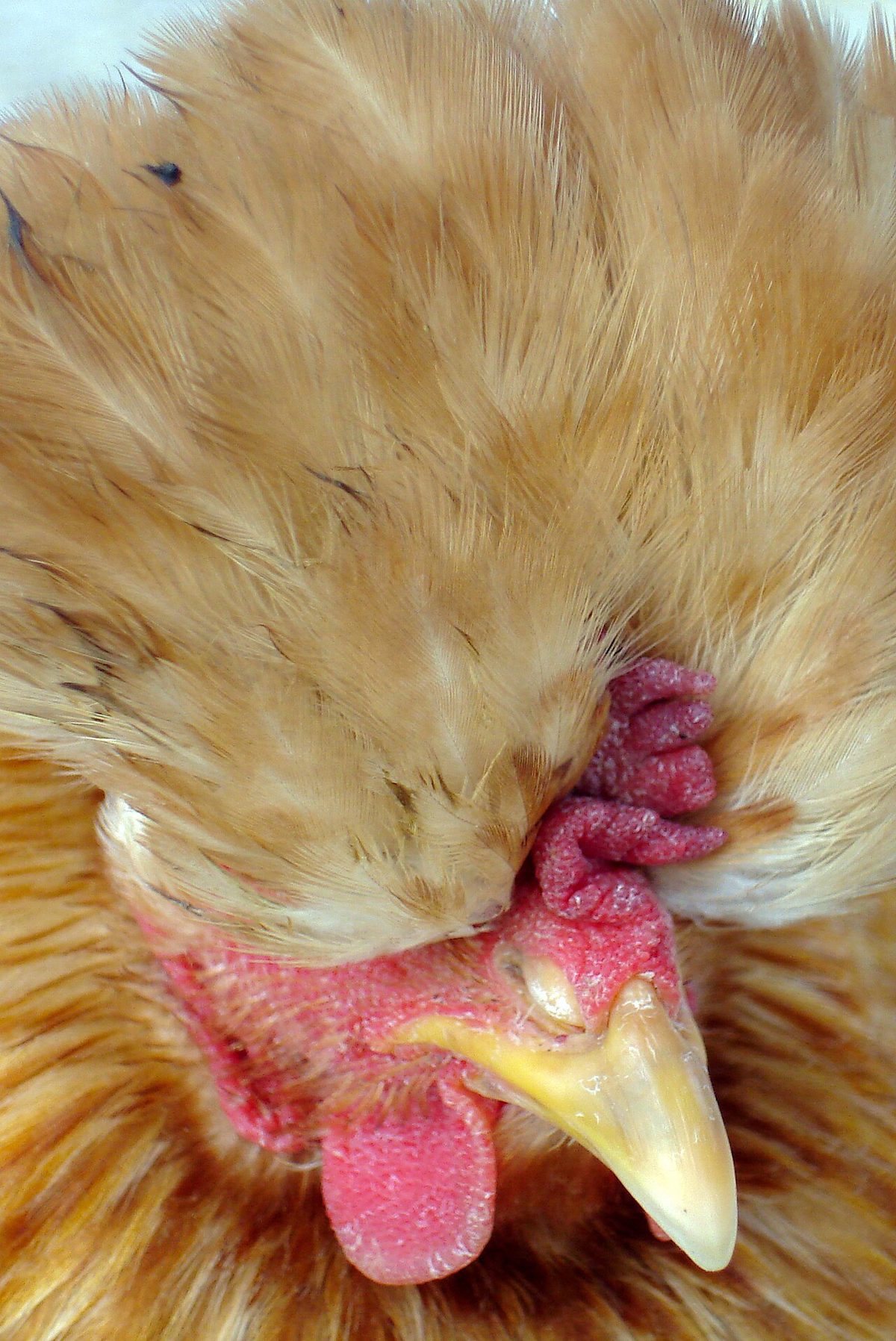
عکس از تاج مرغ-پارک پرندگان بوستان هاشمی by Mostafameraji (CC BY-SA 4.0) · source
The single comb is the shape most people picture when they think of a chicken's comb. It is tall and narrow, standing upright along the centre of the head with evenly spaced points running its length. It is the most common comb type across the world's chicken breeds.
Understanding the single comb matters here for one important historical reason. The Dominique — the breed that sits at the heart of this article — was formally separated from another popular American breed largely because of its comb type.
In the 1860s, farmers in New England crossed Black Java hens with single-combed Dominique males to create a new dual-purpose breed. By 1870, the question of how to classify barred-plumaged birds at a New York poultry show caused enough confusion that organisers made a decisive ruling. Rose-combed barred birds would be exhibited as Dominiques. Single-combed barred birds would be entered as Plymouth Rocks instead.
That ruling was confirmed in an 1871 Standard of Excellence for the Dominique and carried into the first American Standard of Perfection in 1874. From that point on, the rose comb became the defining feature that separated the Dominique from the Plymouth Rock. Single comb, in other words, is not just a comb shape — it is part of the story of how the Dominique breed earned its own identity.
Rose Comb
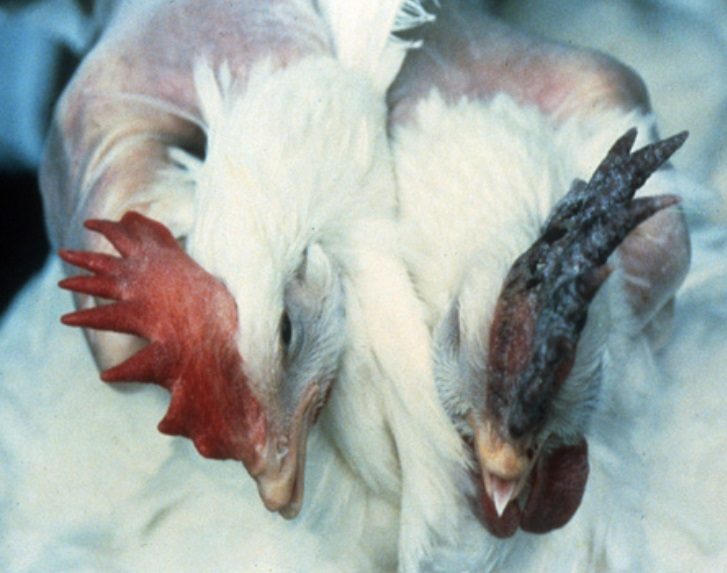
Discolored chicken comb by USDA file photo (Public domain) · source
The rose comb is a broad, low, bumpy structure that sits close to the skull. It looks rather like a half-sphere of small, tight points rather than tall spikes, and most rose-combed breeds carry a single small spike pointing backwards at the rear.
This shape is more than cosmetic. Because the comb sits low and close to the head, it is far less vulnerable to frostbite in cold weather than the tall, exposed single comb. That practical advantage is one reason so many northern European and North American heritage breeds carry the rose comb.
The four breeds discussed below each carry a rose comb (with one notable exception). Their histories, looks, and usefulness to farmers differ considerably, as do their conservation statuses.
Cushion Comb
Chicken Egg without Eggshell 5859 by Biswarup Ganguly (CC BY 3.0) · source
The cushion comb is small, flat, and compact — a low mound of small bumps rather than the broad, ridged rose comb or the tall, pointed single comb. Like the rose comb, it sits close to the head and offers better frostbite protection than a single comb in freezing conditions.
The cushion comb is worth mentioning in this article because the Chantecler — a breed that comes up often in conversations about cold-hardy chickens — carries one. The Chantecler is the only chicken breed that originated in Canada and one of just three livestock breeds developed in Quebec. It was created from about 1908 at the Oka Agricultural Institute in that province, with the explicit aim of producing a chicken that could survive and produce eggs through Canada's long, bitter winters.
The Chantecler's cushion comb, combined with small or vestigial wattles, thick close feathering, and a generous layer of down, makes it far more resistant to extreme cold than many other breeds. But it is not a rose comb. If you are specifically looking for rose-combed breeds, the Chantecler belongs in the conversation as a closely related cold-weather alternative — not as a direct match.
The Dominique
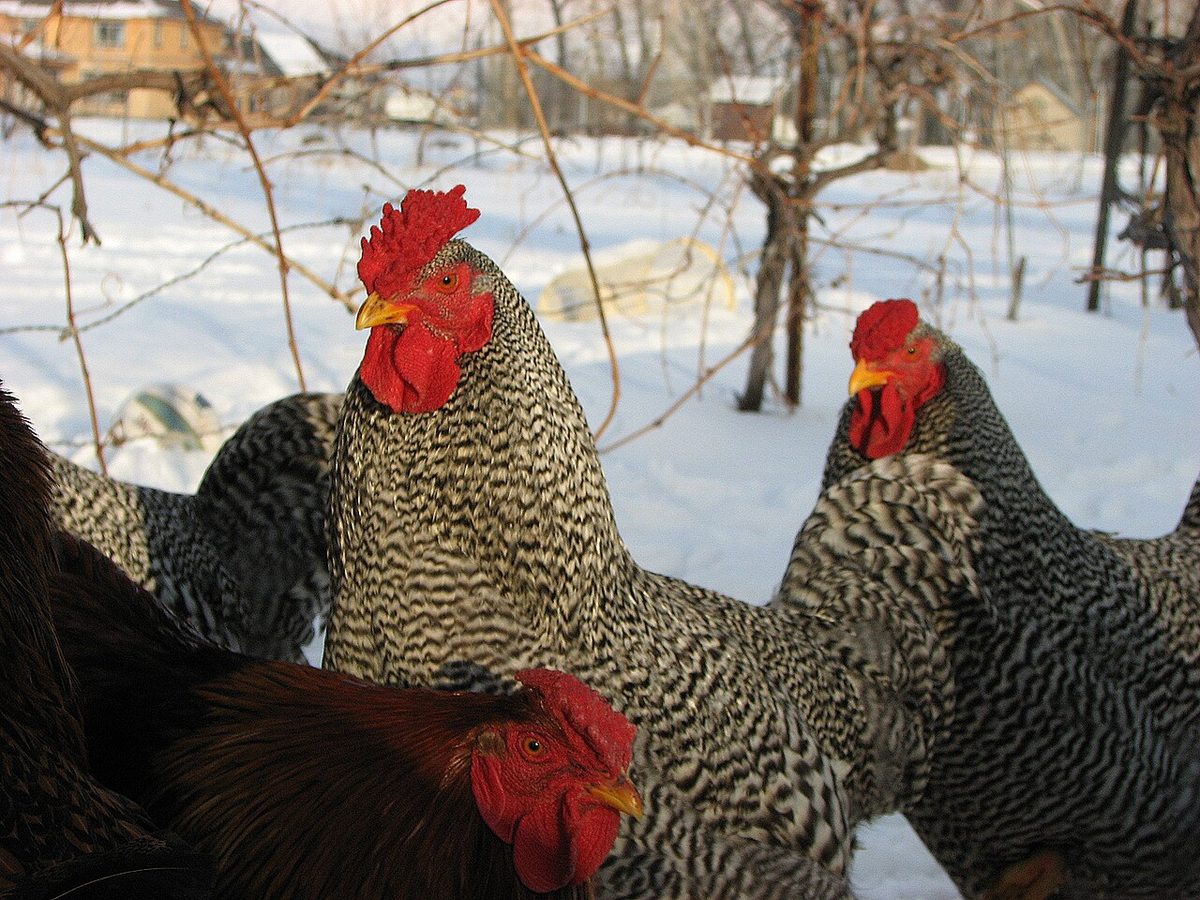
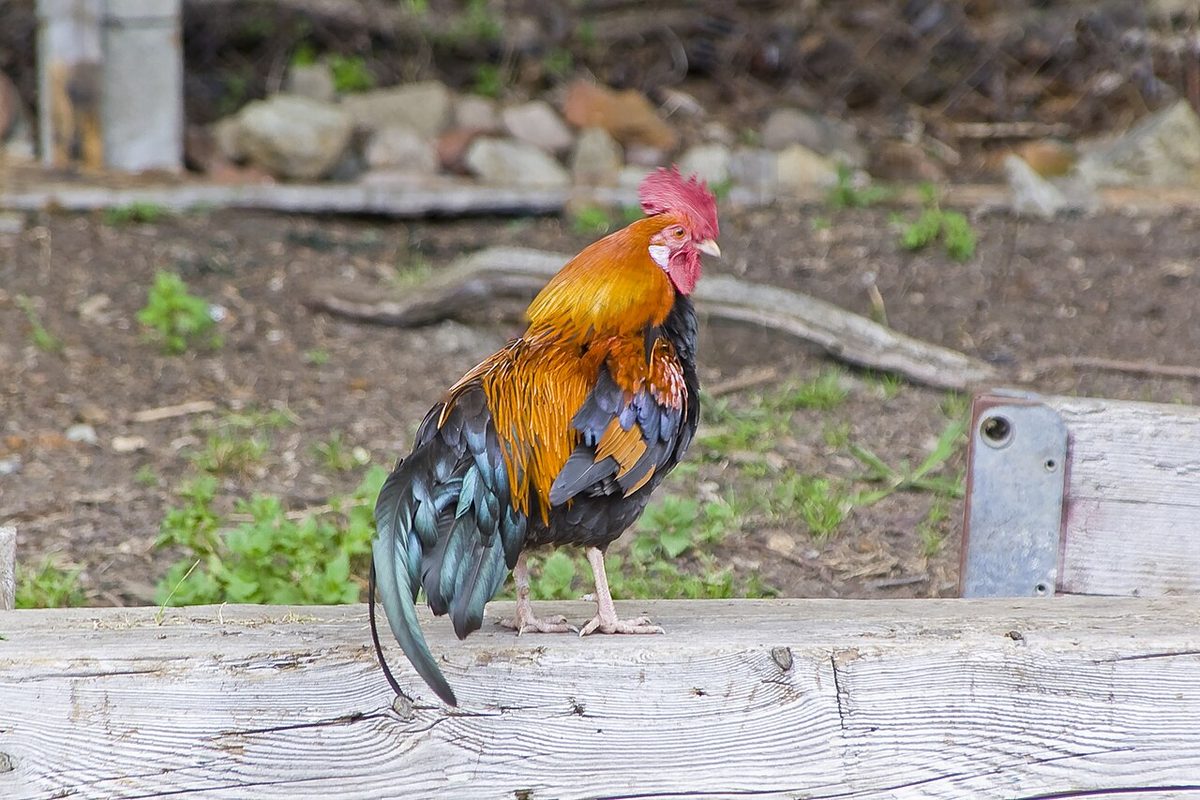
DominiqueCockZeus by Original uploader was JapanBreakfast at en.wikipedia (CC BY-SA 3.0) · source
The Dominique is the oldest American chicken breed, well established by about 1750 and descended from birds brought over by English colonists. It is defined by its rose comb with a single backwards-pointing spike, along with red earlobes and wattles and a yellow beak. The plumage is cuckoo — regular light and dark barring — and held tight to the body.
That tight plumage and the rose comb together give the Dominique a practical advantage over breeds with large, floppy single combs. Frostbite on the comb is a genuine risk for free-range chickens kept through northern winters, and the Dominique's anatomy makes it more resistant. For keepers in cold climates, that difference can matter.
The Dominique is a dual-purpose breed, kept principally for brown eggs. Hens lay approximately 200 brown eggs per year, each averaging 58 g.
Weight
Hens: 1.75–2.25 kg
Cocks: 2.0–2.5 kg
Conservation status
Breed numbers dropped sharply over the course of the twentieth century. By the 1970s, fewer than 500 breeding birds remained in North America and the American Livestock Breeds Conservancy listed the Dominique as critical. A focused recovery initiative brought numbers back up. By 2021 the breed had improved to watch status on the Livestock Conservancy list and was reported to DAD-IS as not at risk. It is a genuine conservation success story — and a reminder of how quickly a common breed can slip toward extinction if no one is paying attention.
The Leghorn
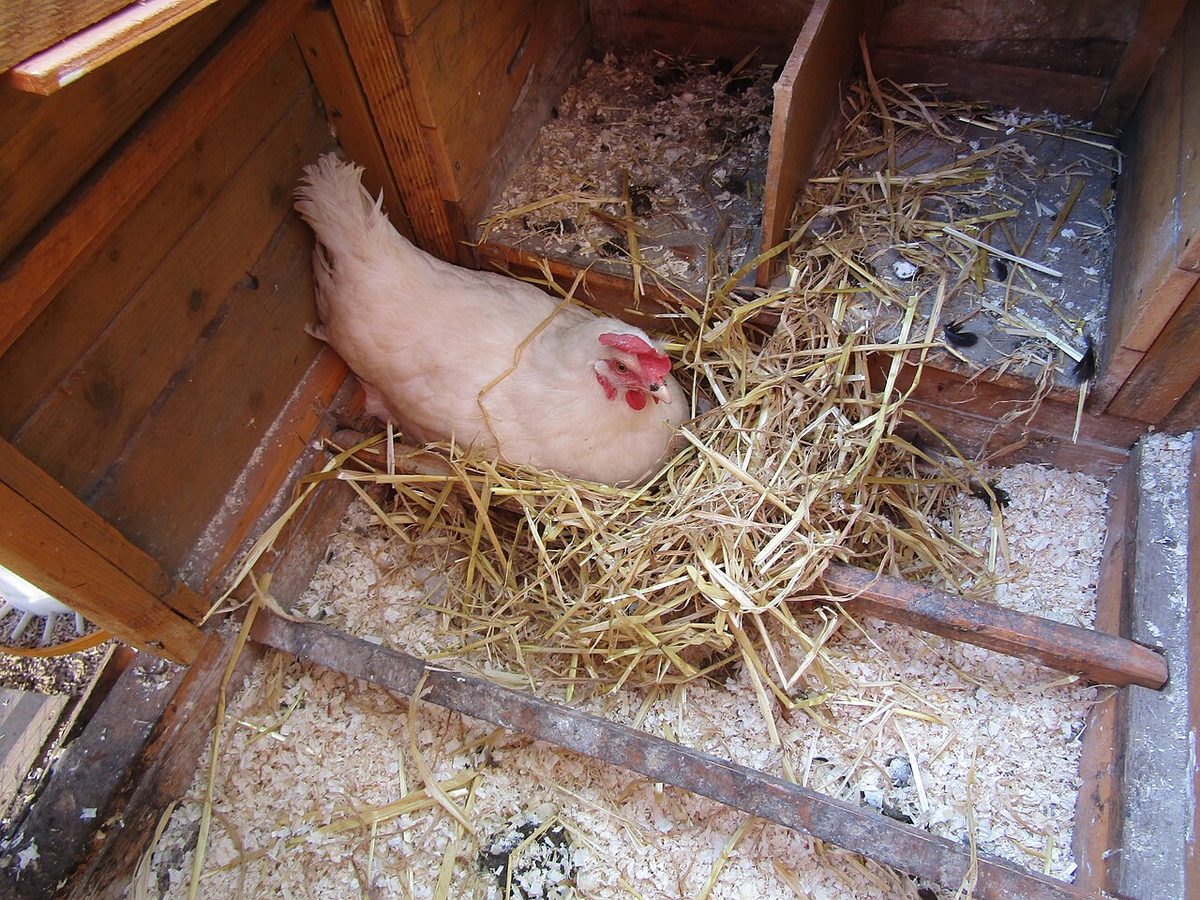
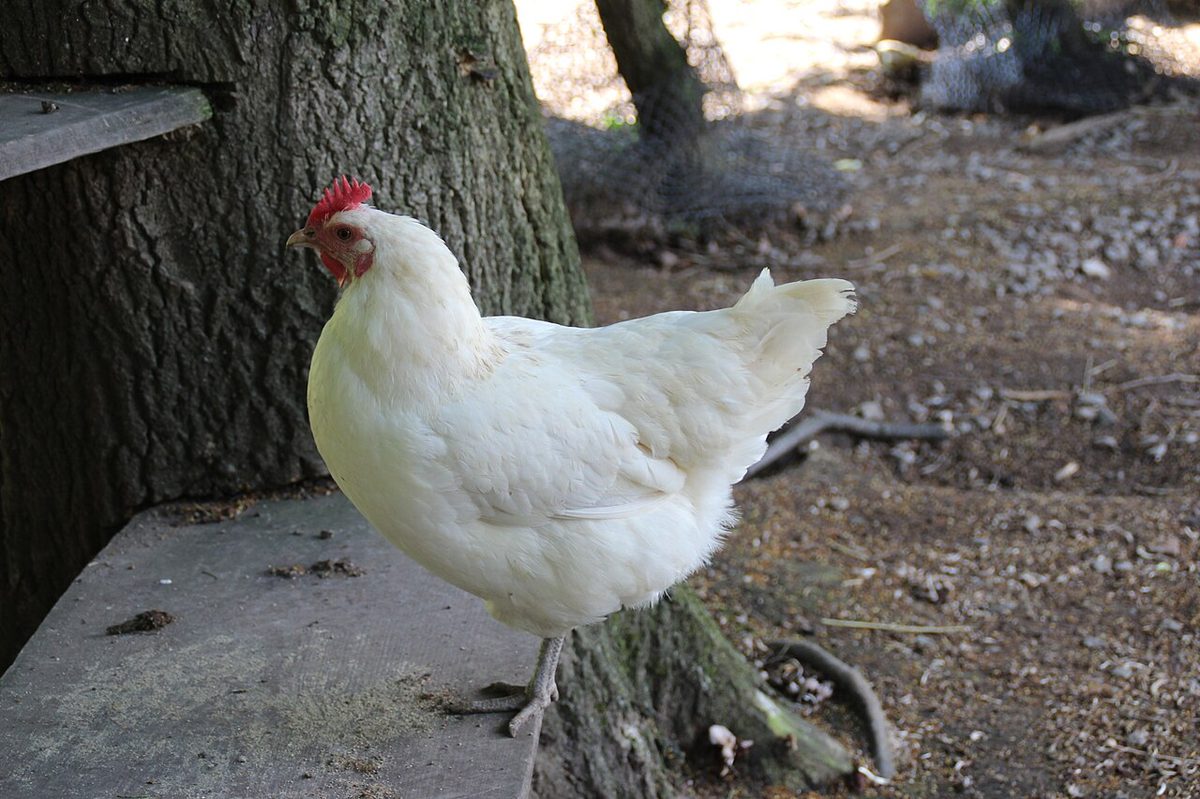
2020-09-15 Broody Leghorn chicken, Norfolk by Kolforn (Kolforn)
I'd appreciate if you could mail me (Kolforn@gmail.com) if you want to use this picture out of the Wikimedia project scope.
This file is licensed under the Creative Commons Attribution-Share Alike 4.0 International license.
You are free:
to share – to copy, distribute and transmit the work
to remix – to adapt the work
Under the following conditions:
attribution – You must give appropriate credit, provide a link to the license, and indicate if changes were made. You may do so in any reasonable manner, but not in any way that suggests the licensor endorses you or your use.
share alike – If you remix, transform, or build upon the material, you must distribute your contributions under the same or compatible license as the original.https://creativecommons.org/licenses/by-sa/4.0CC BY-SA 4.0 Creative Commons Attribution-Share Alike 4.0 truetrue (CC BY-SA 4.0) · source
White Leghorns are the most widely used commercial layer breed in the world. They have been used extensively to create the high-producing hybrid layers that supply most of the white eggs sold in supermarkets. In the United States, rose-comb colour varieties are officially recognised in the Standard of Perfection, with six colour varieties listed across additions made from 1883 through 1981. Britain's Leghorn Club goes further, permitting rose comb across eighteen colour varieties. The French federation divides Leghorns into American, English, and Italian types and lists many colour variants.
Italy, however, does not permit the rose comb at all. The Italian standard for the Livorno — the local name for the Leghorn — does not recognise it. So if you are buying breeding stock or showing birds in Italy, the rose-comb Leghorn simply does not exist under the local rules. That is a good example of why it always pays to check the breed standards that apply in your own country.
Egg production
Average: 280 white eggs per year
Top performers: sometimes 300–320
Minimum egg weight: at least 55 g per egg
Weight (Italian standard)
Cocks: 2.4–2.7 kg
Hens: 2.0–2.3 kg
If maximum egg output is your main goal, the Leghorn is the breed to look at. It will out-lay almost any other pure layer breed. Keep in mind that production figures like these depend heavily on management, nutrition, and housing — your local conditions may give different results.
The Wyandotte
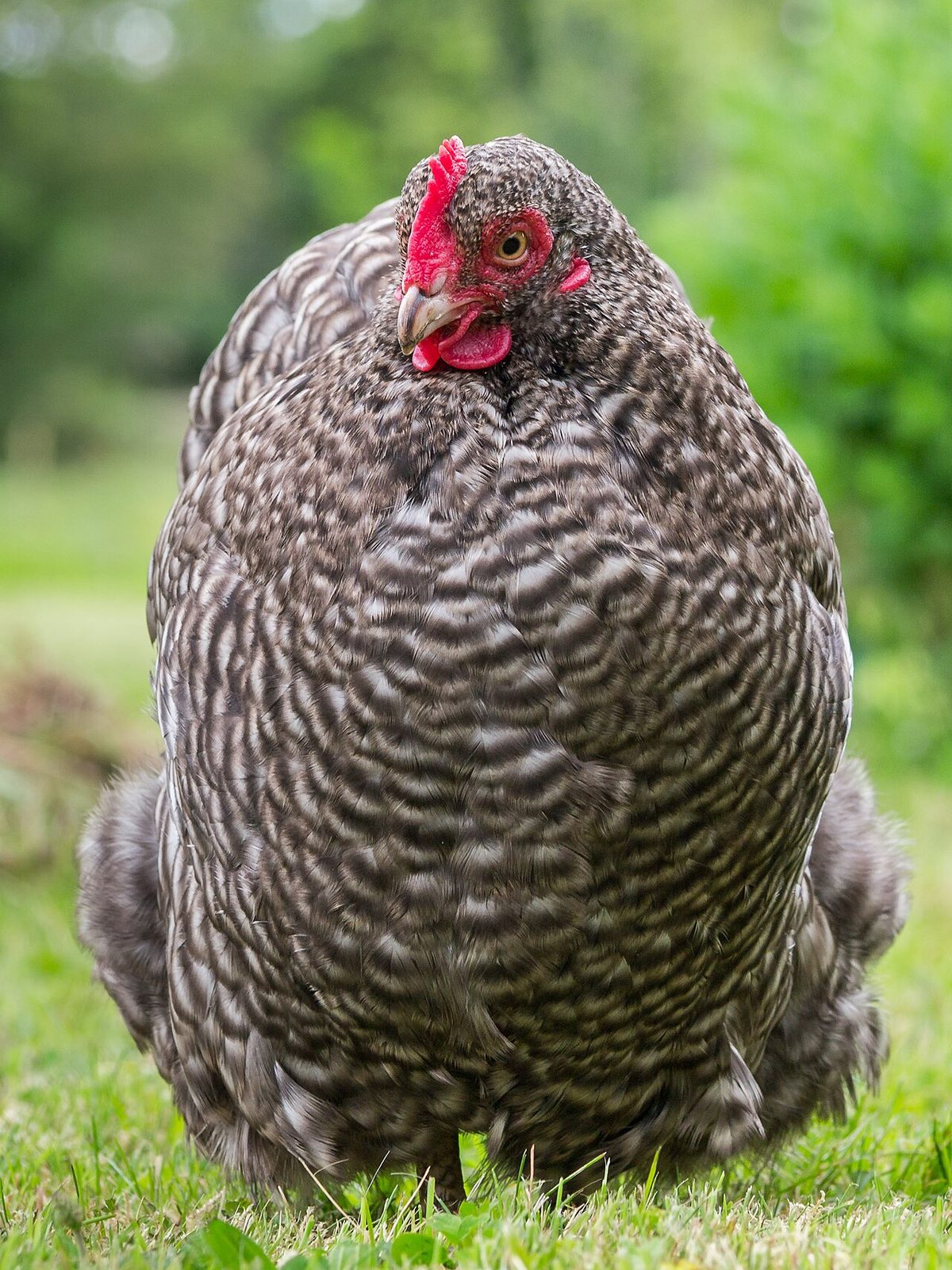
Bonte wyandotte kip by Uberprutser (CC BY-SA 4.0) · source
The Wyandotte was developed in the United States in the 1870s and named after the Wyandot people. Its broad rose comb is thought to come from spangled Hamburgs in its ancestry, while the colour pattern owes something to dark Brahmas. It is a solid dual-purpose breed: hens lay brown eggs and the carcass provides well-fleshed, yellow-skinned meat.
Weight
Adult birds: 2.7–4 kg
That broad 2.7–4 kg range reflects the variation between the lighter hens and the heavier cocks. It is a substantial bird — noticeably heavier than the Dominique or a standard Leghorn — which means you get a better meat return if you are raising for the table as well as for eggs.
Colour varieties
Nine colour varieties are recognised by the American Poultry Association. The Entente Européenne goes further still, recognising up to thirty. That wide variety of colours — from silver-laced to blue-laced red to partridge — is one reason the Wyandotte has become a favourite with show breeders.
Conservation and show popularity
The Wyandotte was listed as recovering by the American Livestock Conservancy in 2015 and was removed from the priority list entirely by 2016, which is good news for anyone interested in heritage genetics. In Germany, the Wyandotte is particularly popular as a show bird and currently sits in category IV — alert — on the German Rote Liste. That contrast, with the breed secure in North America but still monitored in Europe, shows how conservation status can differ from one country to another.
The Chantecler
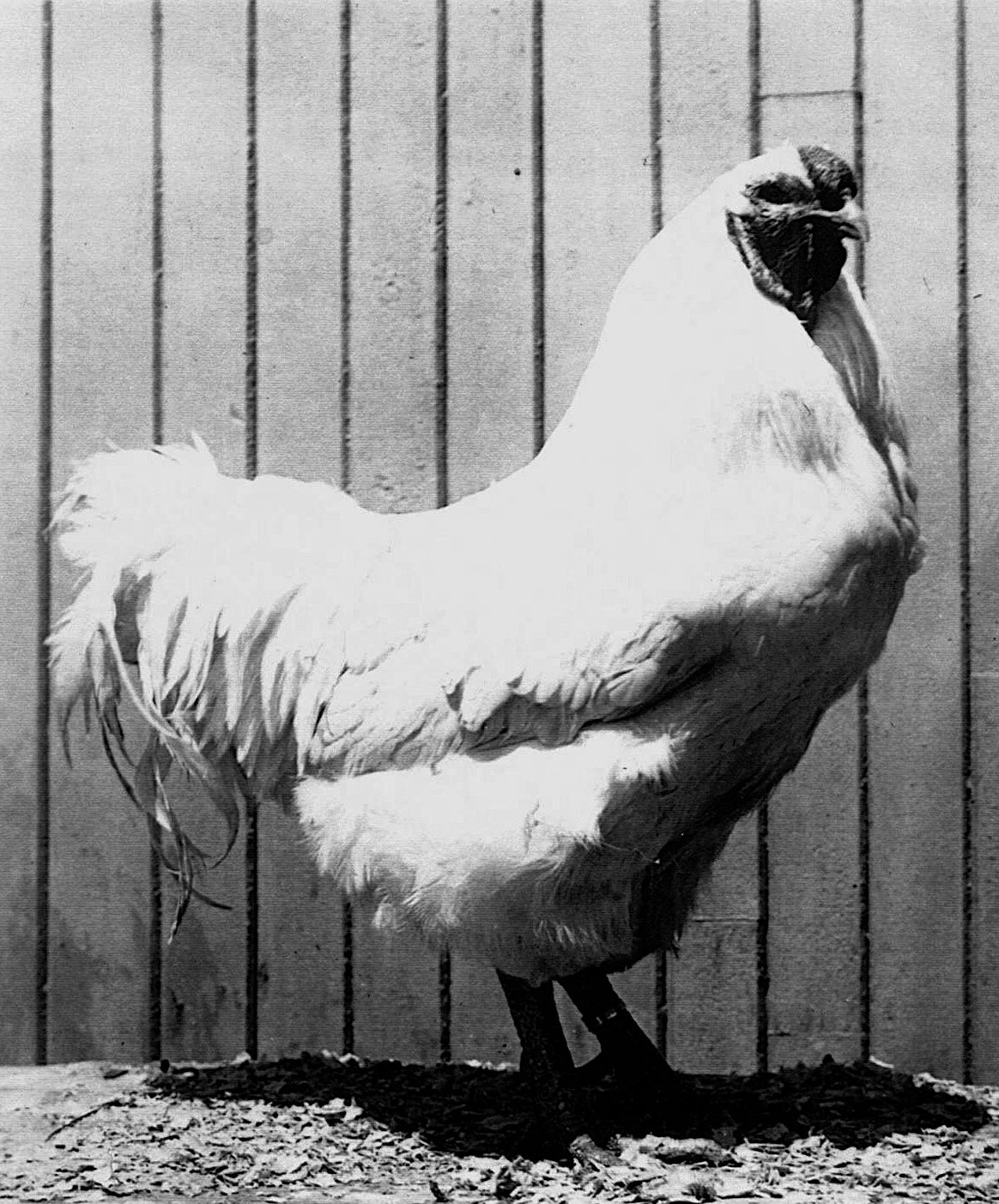
Chantecler coq 1926 by Unknown authorUnknown author (Public domain) · source
The Chantecler is the only breed on this list that does not actually have a rose comb. It carries a cushion comb instead — small, flat, and low. But it belongs in any conversation about cold-hardy egg-laying breeds, and it is the breed most closely associated with Canada.
Bred from about 1908 at the Oka Agricultural Institute in Quebec, the Chantecler was designed from the start to cope with harsh winters. Its cushion comb, small wattles, thick close feathering, and dense down all serve the same purpose: reducing exposed skin where frostbite could take hold. Where the Dominique has a rose comb and the Chantecler a cushion comb, both were shaped by the same problem — how to keep layers productive through a long, freezing winter.
Egg production
Approximately 200 light brown eggs per year
Average egg weight: approximately 60 g
Weight
Hens: 2–2.5 kg
Cocks: 3.4–3.9 kg
Conservation status
This is a breed that genuinely needs help. The Chantecler is listed as at risk/endangered in DAD-IS and as watch by the US Livestock Conservancy. A population of 500–1,100 birds was reported to DAD-IS in 2017, and an estimated 1,000–1,500 birds remained in Canada as of 2007. Those are small numbers for a breed that carries a unique piece of Canadian agricultural history. Supporting Chantecler breeders is one of the more concrete things a small-scale keeper can do for heritage conservation.
Comparing the Four Breeds at a Glance
SAPS analysis comparing human LIN-52 to chicken LIN-52 by SharnKB (CC BY 4.0) · source
The table below pulls together the key facts from the sections above so you can compare them side by side.
Breed
Comb type
Eggs per year
Egg colour
Egg weight
Hen weight
Cock weight
Conservation status
Dominique
Rose comb (with backwards spike)
~200
Brown
58 g
1.75–2.25 kg
2.0–2.5 kg
Watch (Livestock Conservancy); not at risk (DAD-IS)
Leghorn
Rose comb (in some countries)
280 (sometimes 300–320)
White
At least 55 g
2.0–2.3 kg (Italian standard)
2.4–2.7 kg (Italian standard)
Not at risk globally
Wyandotte
Broad rose comb
Not specified in sources
Brown
Not specified in sources
Included in 2.7–4 kg range
2.7–4 kg
Removed from priority list (US); alert in Germany
Chantecler
Cushion comb (not a rose comb)
~200
Light brown
Approximately 60 g
2–2.5 kg
3.4–3.9 kg
At risk/endangered (DAD-IS); watch (US)
Cold Hardiness and Climate Considerations
If you keep chickens in a climate with hard frosts and long winters, the shape of the comb matters more than you might think. A large, tall single comb is essentially a flag of exposed flesh that can freeze, causing permanent damage or dropping the bird into a dangerous moult. Rose combs and cushion combs sit low against the skull and stay warmer.
The Dominique's rose comb, paired with plumage that is held tight to the body, gives the breed better frostbite resistance than many common breeds. That makes it one of the more practical choices for a free-range keeper in a cold climate.
The Chantecler goes further. Every part of its design — cushion comb, tiny wattles, thick feathers, dense down — was selected for survival under Canadian winter conditions. It does not have a rose comb, but if cold hardiness is your main criterion, it is the breed that has been most deliberately built for it.
The Wyandotte, with its broad but still reasonably low rose comb, sits somewhere in between. It was developed in the 1870s United States rather than the deep freeze of Quebec, but its comb type is still better suited to cold than a single comb would be.
Conclusion
Conclusion
Rose combs are more than a pretty detail. They are a genuine advantage for anyone keeping hens in a northern climate. They resist frostbite, they keep your bird comfortable, and they do not get in the way.
If you want a reliable layer, the Leghorn will not let you down. If you want a dual-purpose bird that handles both cold and family life, the Rhode Island Red is hard to beat. If you want something with presence and a calm temperament, look at the Brahma. And if you want a breed with real character and striking looks, the Wyandotte is a wonderful all-rounder.
All four breeds are widely available in Australia, the United States, Canada, the United Kingdom, and across Europe. Most hatcheries will ship day-old chicks to your door. Whichever one you choose, you are picking a bird that was shaped by real farmers over many generations — and that is a good thing to base a decision on.
Frequently Asked Questions
Can a hen with a rose comb still go broody?
Yes. The comb type has no effect on mothering instincts. Breeds like the Rhode Island Red and Wyandotte can and do go broody, though some strains have been bred to be less broody over time.
Are rose-comb roosters fertile?
Yes, they are fully fertile. The comb shape does not affect reproduction. If you plan to hatch your own eggs, any rose-comb rooster will do the job perfectly well.
Do I need to do anything special for a rose comb?
Not really. Just keep an eye on it in very hot weather, as with any comb type. Make sure your birds have shade and fresh water in summer. In cold weather, the rose comb will mostly look after itself.
❓ Frequently asked questions
Which chicken breeds have a rose comb?
The Dominique is defined by its rose comb, which has a single backwards-pointing spike. The Leghorn carries a rose comb in some countries — the US Standard of Perfection, for example, recognises six rose-combed colour varieties. The Wyandotte has a broad rose comb thought to derive from spangled Hamburgs. By contrast, the Chantecler has a small cushion comb, not a rose comb.
Are rose-comb chickens better suited to cold climates?
The Dominique's tight plumage and rose comb give it better frostbite resistance than breeds with large single combs. The Chantecler was bred for Canadian winters, but it uses a cushion comb and dense down rather than a rose comb. How much a rose comb alone helps with cold beyond these examples depends on the local climate and flock conditions.
Which rose-comb breeds are endangered or at risk?
The Dominique was listed as 'critical' by the American Livestock Breeds Conservancy in the 1970s, but it recovered to 'watch' status by 2021 and 'not at risk' on DAD-IS. The Wyandotte was listed as 'recovering' in 2015 and removed from the priority list in 2016. The Chantecler, which is not rose-combed, is listed as 'at risk/endangered' in DAD-IS, with 500–1,100 birds reported in 2017.
How many eggs do rose-comb breeds lay?
White Leghorns average 280 eggs per year and sometimes reach 300–320, with each egg weighing at least 55 g. Dominique hens lay about 200 brown eggs per year averaging 58 g. Chantecler hens, though not rose-combed, lay about 200 light brown eggs per year averaging approximately 60 g.
📚 Where the figures in this guide come from
We read what has already been published on the subject, take out the figures and rules it actually states, and write it up in plain, everyday language.
Every number and name here traces back to a source listed below — nothing in this guide is invented.
Our own records
Price observations recorded by this site (worldwide)
Prices, rules and animal health advice change and vary by area. Check anything important with a local vet, dealer or agriculture office before you spend money.
Spotted a mistake? Tell us in the comments and we will correct it.

 Menu
Menu
💬 Comments
Login to comment
No comments yet. Be the first to share your experience!