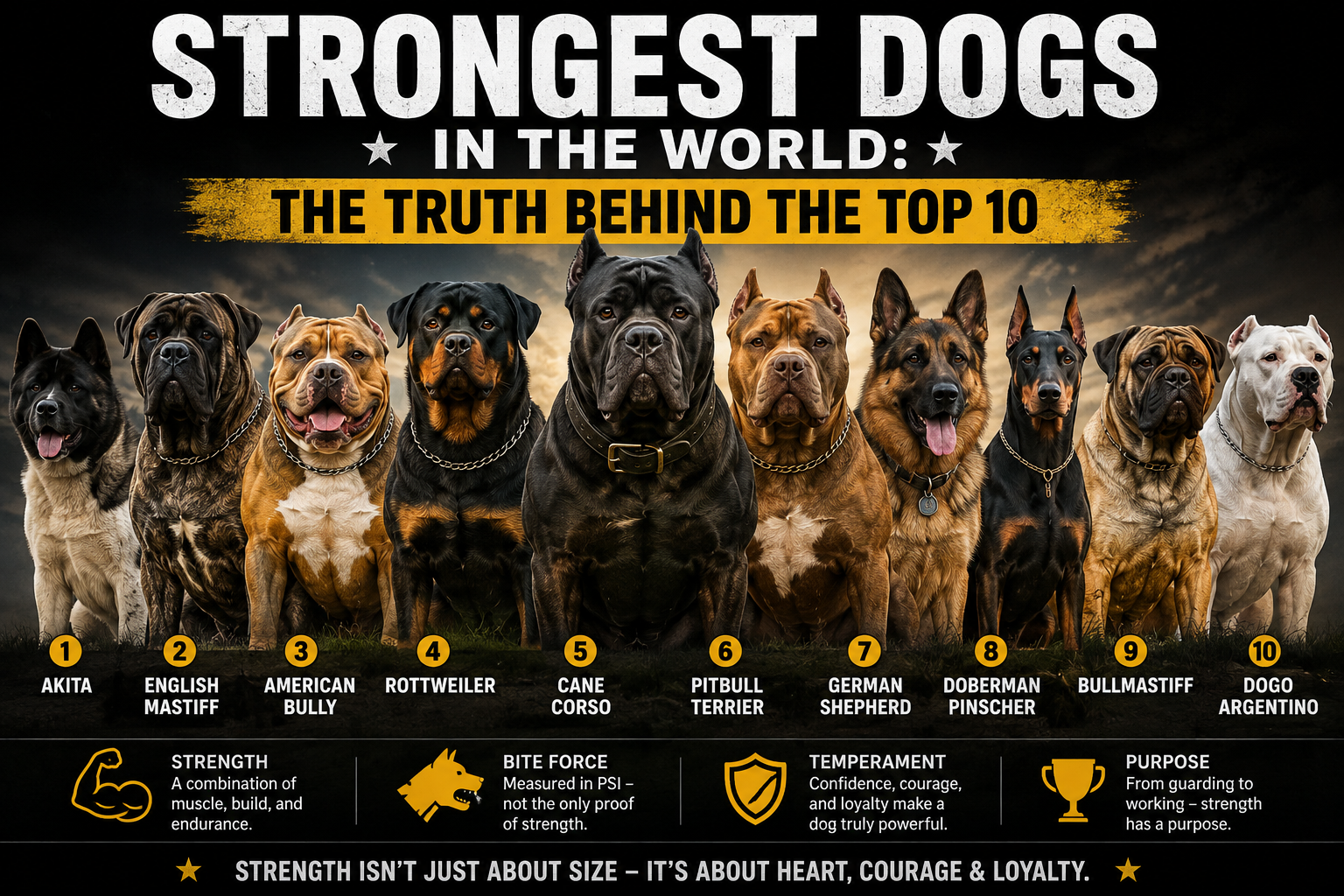
There is no honest top 10 of the strongest dogs in the world. Nobody has ever put the big breeds through the same strength test, so any list that ranks them one to ten is guesswork wearing a suit.
What can be said honestly is narrower, but far more useful to you: which breeds were deliberately bred for power, what job made them that way, and whether a dog like that could live with your family or guard your stock. That is what follows.
Why you will not find a real top 10 anywhere
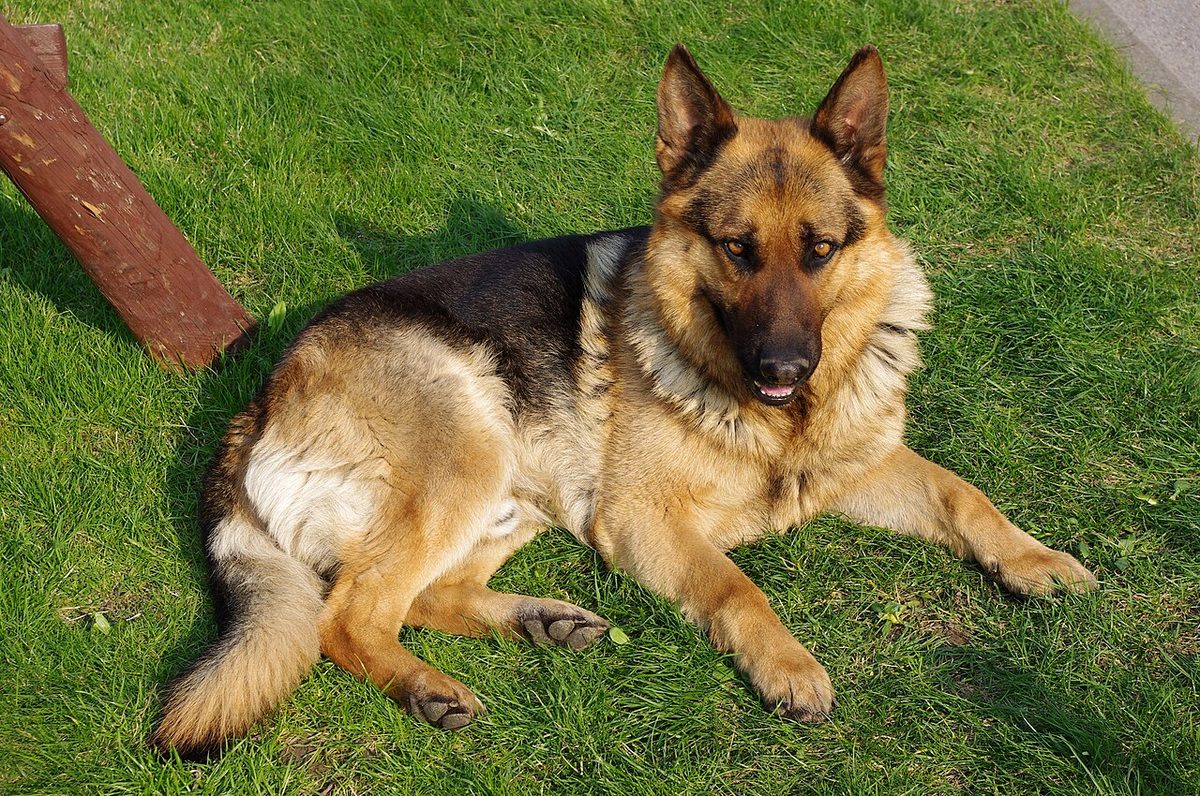
Strength in dogs gets talked about much more than it gets measured. There is no agreed way to test how strong a dog is, and no set of comparable bite force or pulling figures that covers the big breeds. So when you see a number attached to a breed, ask where it came from. Even plain body measurements are scarce: one of the most famous powerful breeds, the German Shepherd, is usually described only as "medium to large".
What every dog does share is worth knowing:
- Apart from the tail, all dogs have the same number of bones.
- All have powerful jaws holding around 42 teeth.
- All have well-developed senses of smell, hearing and sight. Smell and hearing beat yours easily; eyesight is less sharp than yours.
- Because dogs have lived alongside people so long, they can thrive on a starch-rich diet that would not be enough for other members of the dog family.
Dogs have been bred for the behaviours, senses and physical traits people wanted, and breeds now vary widely in shape, size and colour. None of that variation has ever been sorted into a power league table.
Even the dog's name is still argued over. Linnaeus, in 1758, listed the domestic dog as Canis familiaris and the grey wolf as Canis lupus on the next page, treating them as separate species because of the dog's upturning tail. In the 2005 edition of Mammal Species of the World, Wozencraft listed familiaris as a subspecies of Canis lupus. Some writers use one name, others the other. If the experts cannot settle what to call a dog, treat a tidy ranking of the ten strongest with care.
The closest thing to a strength contest that ever existed
There is one real tradition of picking the strongest dog, and it belongs to the herders of the Central Asian Shepherd. Once a year, all the herders from the same area met and set their strongest sheep guardian males against each other to find a winner.
It was about dominance, not about destroying their own dogs. Most dogs simply sized each other up, and the weaker or more submissive one walked away. They seldom injured each other, and what they did inflict was mostly minor scratches, over a short period. Only the leaders had to settle the question of the strongest by fighting. Set against the dogs' everyday duties — facing predators and venomous snakes — the yearly contest was a small matter.
Dog fighting is described as a national tradition in many countries of the Central Asian region, but the old herders' version and today's commercial fights are not the same thing. They differ in rules and in the dogs used, as much as a livestock guardian differs from a fighting dog. Some communities keep the traditional herders' test of dominance; others run modern commercial fights. If someone offers to show you either, it is worth knowing which one you are looking at.
The breeds this "strongest dog" story is actually built on
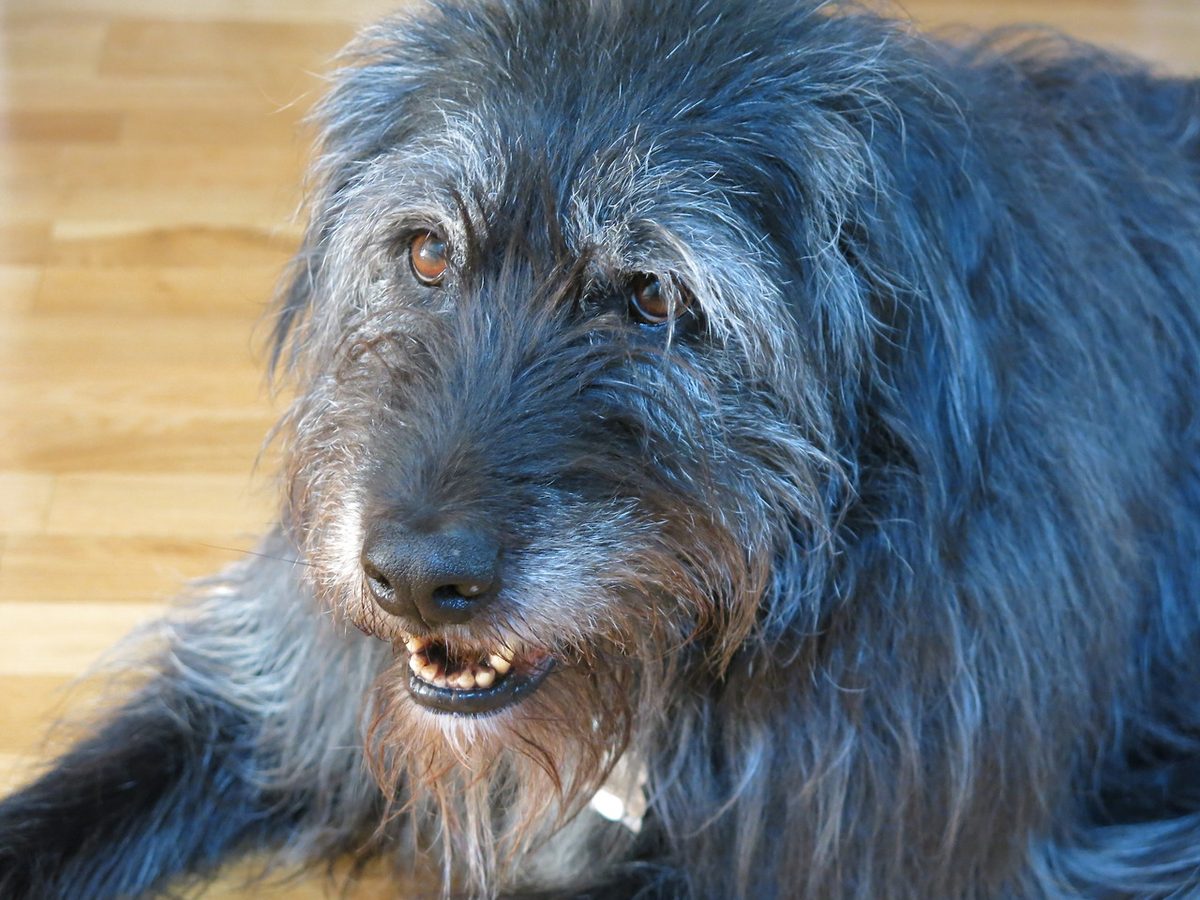
Here is the awkward truth behind the top 10: the honest list is shorter than ten. These are the breeds that can be spoken about with any confidence.
- Central Asian Shepherd: home ground stretches between the Ural, the Caspian Sea, Asia Minor and the north-west border of China. Bred to guard sheep and goat herds against predators and venomous snakes.
- German Shepherd: built from traditional German herding dogs from 1899. Bred to herd sheep and protect flocks, and now used far beyond farming.
- Kangal, Akbash and Georgian Shepherd (Nagazi): aboriginal livestock guardian breeds of the same region, closely related to the Central Asian Shepherd.
Central Asian Shepherd (Alabai, Töbet, Turkmen Wolf-Hound)
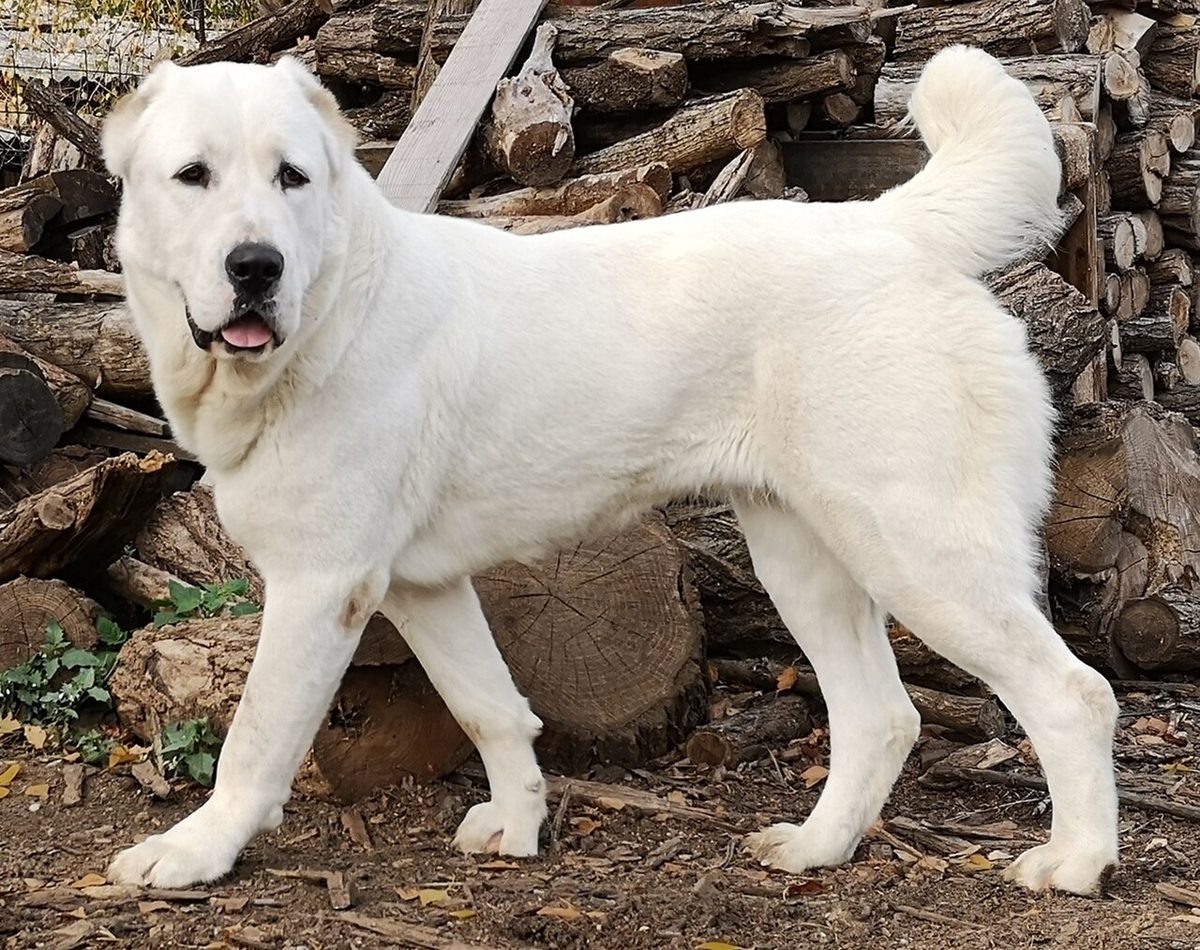
Aboriginal dogs and their mixes are still found in Kyrgyzstan, Tajikistan, Turkmenistan, Kazakhstan, Afghanistan, Uzbekistan and surrounding countries. Local names include the Turkmen Alabaý and the Kazakh Төбет. The traditional work was guarding sheep and goat herds, plus general protection and guard duty.
Purebred dogs are said to carry a set of features of their own: very noticeable, extremely flexible joints, false ribs, a specific head set, and a very strong neck with a massive dewlap, finished by expressive, almost human eyes that show the dog's intelligence.
It is not one uniform animal. The breed takes in numerous types that differ in size, colour, head type and hair type, and puppies with different working qualities are normally born in the same litter. That makes writing a single breed standard difficult. In Turkmenistan the dog is a matter of national pride: the standard for the Turkmen Wolf-Hound was approved by the State Agroindustrial Committee in 1990, and a gold statue of the breed was unveiled in 2020. It has been introduced to the worldwide sheep breeding community with great success, though demand is not what it used to be.
German Shepherd (the Alsatian in Britain)
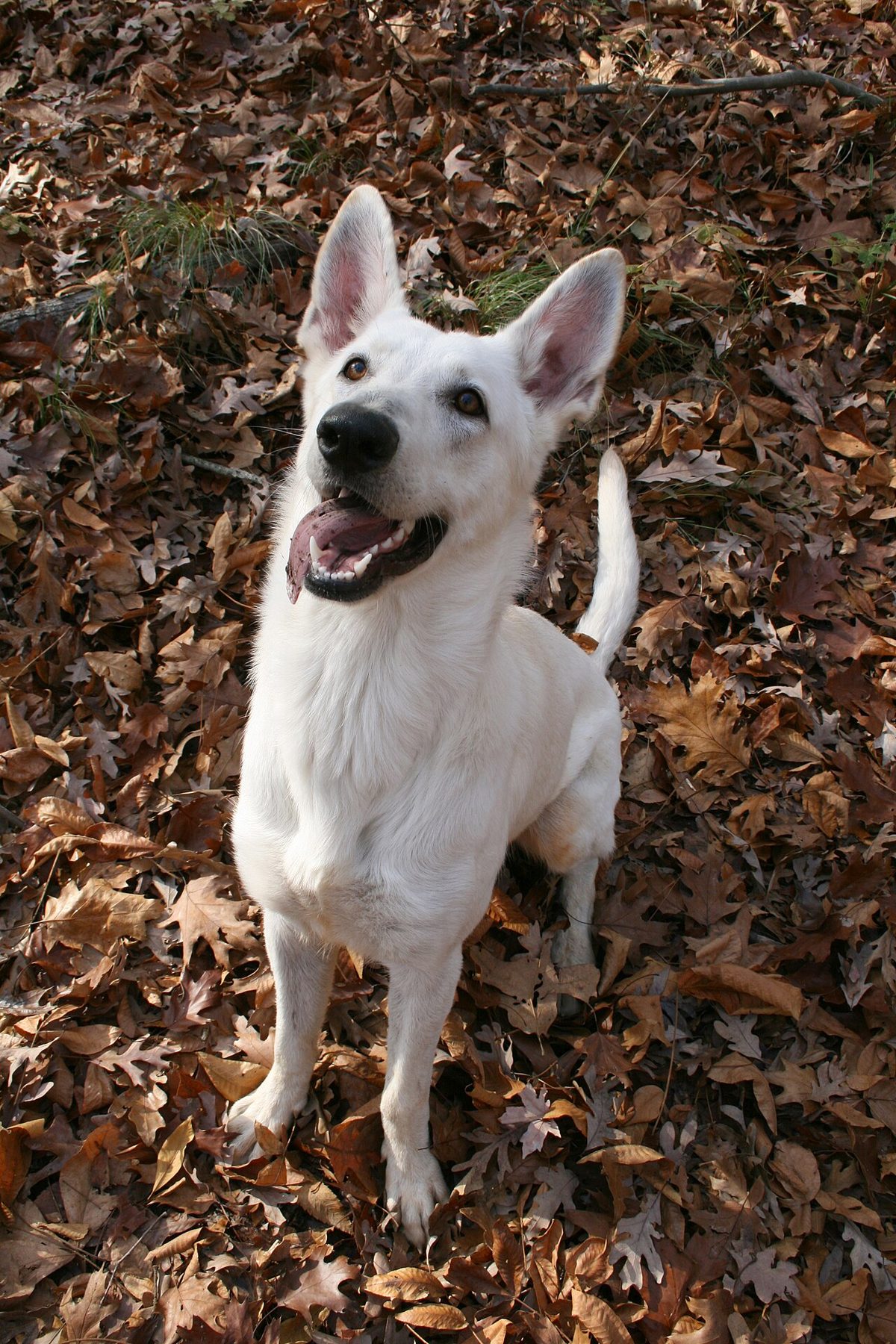
In the 1890s, German shepherds were breeding dogs to hold on to the traits their work needed: intelligence, speed, strength and a keen sense of smell. The Phylax Society, formed in 1891, tried to standardise German breeds and broke up after only three years.
Max von Stephanitz admired the intelligence, strength and ability of Germany's native sheepdogs, but could not find one breed that satisfied him as the perfect working dog. At a dog show in 1899 he was shown Hektor Linksrhein. He was pleased with the dog's strength, bought him on the spot, renamed him Horand von Grafrath, and declared him the first German Shepherd Dog.
Horand became the centre-point of the breeding programme, mated with society members' dogs and with dogs from Thuringia, Franconia and Württemberg. His most prolific son, Hektor von Schwaben, was inbred with another of Horand's offspring to produce Heinz von Starkenburg, Beowulf and Pilot, who between them later sired 84 pups, mostly through inbreeding with Hektor's other offspring. The inbreeding was judged necessary to fix the traits being chased, and every German Shepherd draws a genetic link from Beowulf's progeny. The breed gained international recognition after the First World War ended, and by 1923 the Verein für Deutsche Schäferhunde claimed 50,000 dues-paying members in more than 500 branches in Germany alone.
Kangal, Akbash and Georgian Shepherd (Nagazi)
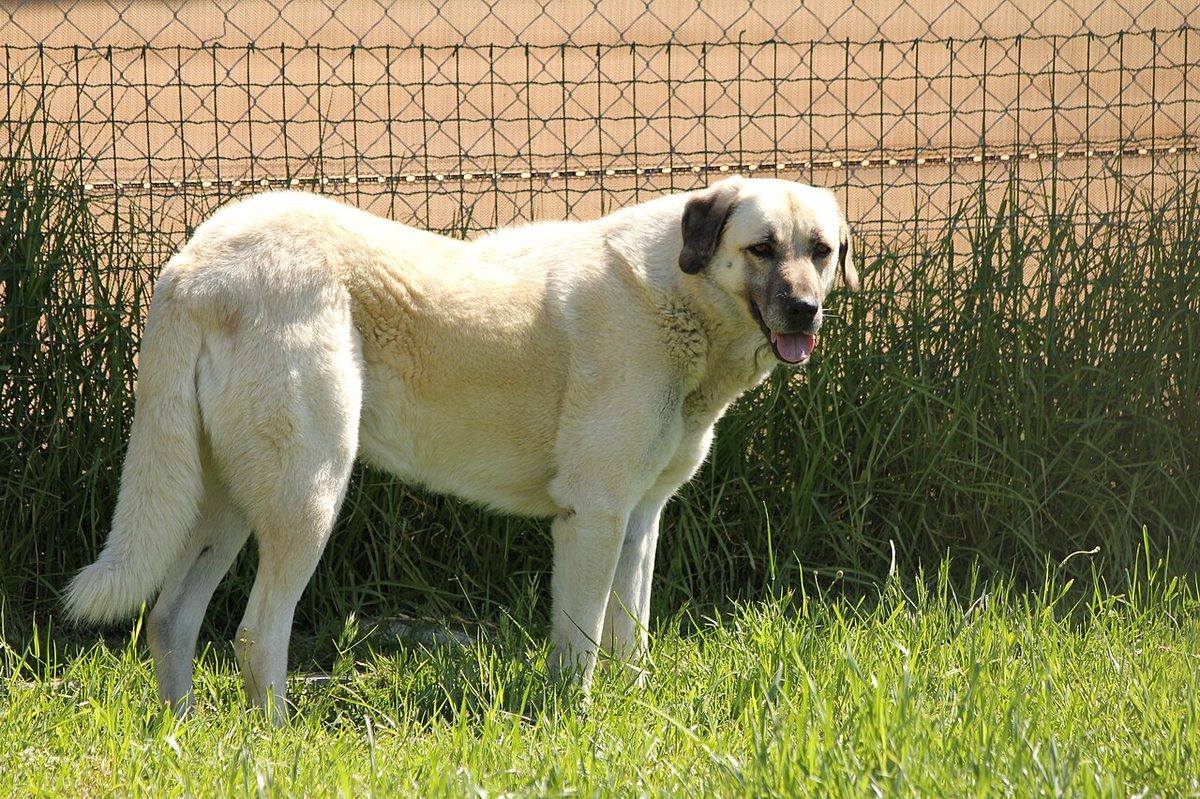
These three appear as close genetic relatives of the Central Asian Shepherd, aboriginal guardians of the same part of the world. Beyond that shared background, there is nothing solid here about their size, strength or temperament. If one of them is the common guardian where you farm, the people worth asking are the herders and vets who handle them every day.
Where the strength really came from
Predators. That is the short answer. The Central Asian Shepherd's daily job was standing between a flock and whatever came for it, snakes included. German herding dogs were bred to move sheep and to protect them from predators. Strength was never selected on its own; it came bundled with intelligence, speed and a good nose, because a dog needed all four to be useful.
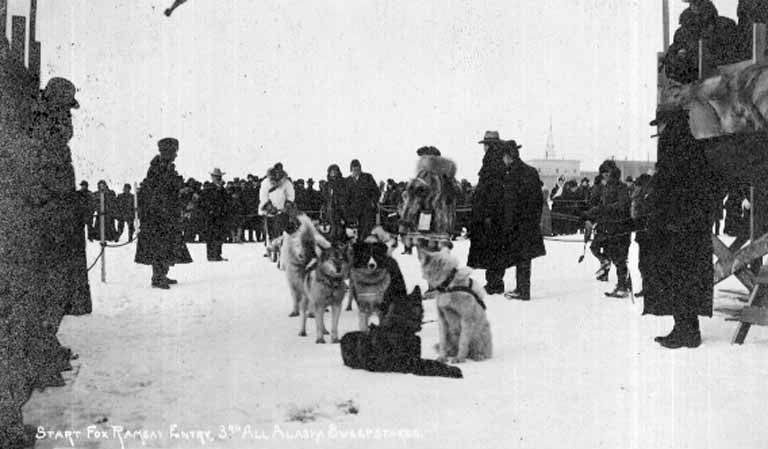
When the work faded, the dogs found other work. As industrialised cities caused predator numbers to fall, sheepdogs were rendered unnecessary. Dogs now do hunting, herding, pulling loads, protection, companionship, therapy, helping disabled people, and assisting police and the military. The German Shepherd, bred as a herder, has since gone into disability assistance, search-and-rescue, police work and warfare, and is among the most frequently registered breeds world-wide. After the Communist revolution, the Soviet government concentrated on working breeds for the Red Army and imported the best Central Asian Shepherds to Russia for military and guard duties; Russian breed experts later developed personal protection dogs out of livestock guardian stock by selecting for working ability.
Pulling loads is on that list of jobs, but no comparable pulling records exist across breeds. So again: if a figure is quoted at you, ask where it was measured.
How far back the story goes
The dates are genuinely unsettled. Some accounts put domestication at over 14,000 years ago, or at least 14,000 years ago; genetic studies suggest the process may have begun over 25,000 years ago; and dogs likely split from wolves somewhere between 27,000 and 40,000 years ago. The earliest conclusively identified domesticated dog, the Bonn-Oberkassel dog, is 14,223 years old and was buried between 14,000 and 15,000 years ago. Remains dating back 30,000 years have been described as Paleolithic dogs, but whether they were dogs or wolves is still debated, because wolves themselves varied a great deal in shape during the Late Pleistocene. Some dogs went the other way entirely: feralization in Oceania over 8,000 years ago produced the dingo and the New Guinea singing dog.
Today the world holds an estimated 700 million to 1 billion dogs. Developed countries account for approximately 20% of them, while around 75% are thought to live in developing countries, mainly as feral and street dogs. In the United States the dog is the most popular pet, found in 34–40% of households.
Bloodline tells you more than the breed name
If you are buying a guardian, this is the section that matters most. Central Asian Shepherds come from working lines, fighting lines and livestock guardian lines, and most dogs used in modern commercial fights come from fighting lines. A high level of aggression toward other dogs can always be expected from a dog with a dog-fighting background. The good news is that most breeders know their dogs' backgrounds and will tell a buyer, so ask the question plainly before money changes hands.
It matters because a guardian has to work as a team to protect sheep. An excessively aggressive dog cannot be a member of the pack, and will not pass that test against the breed's original purpose.
What a sound guardian temperament looks like
A proper working Central Asian Shepherd is protective against human intruders to differing degrees, very territorial, safe with children, loving and respectful toward elderly people, protective of all small animals against predators, and very gentle with the family. Aggression aimed at strangers and friends alike is highly atypical for the breed. Lines bred for personal protection excel in obedience; these dogs make fine house dogs and need no complicated training to learn basic house rules. The German Shepherd, too, is described as intelligent and obedient, and is commonly kept as a companion.
Where the good lines survive
Russian biologists and scientists have studied the dogs of the region since the 18th century. Taking the best representatives to Russia in the Soviet years harmed the local population over the decades, and new breeds arriving in the region led to crossbreeding. Purebred dogs ended up mostly with herders, breed enthusiasts and farms, with a surfeit of crosses elsewhere, though the overall population is still described as stable and still producing true quality working dogs. Trading bloodlines and buying unrelated breeding stock between Russia, other former USSR republics such as Ukraine and Belarus, and countries where the breed remains at an aboriginal stage is common practice.
How many dogs your flock needs, and the age at which a young dog goes out with the sheep, depends on your land, your predators and your neighbours' experience. Ask herders near you and your own vet rather than trusting a rule of thumb from far away.
Reputation, rules and cost: the parts that change where you live
A powerful dog attracts attention, and not all of it is welcome. German Shepherds were popular when they first reached the United States, but as the breed grew more common it became tarred as a dangerous breed kept by gangsters and bootleggers. That reputation travelled: importing German Shepherds was briefly banned in Australia in 1929, and legislation covering all German Shepherds was considered in South Australia. The breed also carries a heavier history, including strong identification with Imperial and Nazi Germany, use as guard dogs at Nazi concentration camps, and Hitler's own dogs — Prinz, acquired in 1921, and Blondi, killed by a cyanide capsule tested by Dr Werner Haase.
Labels can have practical consequences too. In Australia, how the dingo should be classified is disputed and politically charged: treating dingoes as wild dogs makes it simpler to reduce or control populations that threaten livestock, while treating them as a separate species allows conservation programmes to protect them. A 2019 IUCN/SSC Canid Specialist Group workshop considered the dingo and the New Guinea singing dog to be feral Canis familiaris, and therefore did not assess them for the IUCN Red List.
Two things you must check locally rather than online. First, breed rules, licences, insurance and import conditions differ from country to country and often from district to district, so ask your local authority office before you commit. Second, lifespan, health checks, vaccination, parasite control and feed amounts for a big working dog are matters for a vet near you.
Price is the same story. Our own price records run to 75,264 rows across all countries, and they cover livestock and crops only — heifers, cows, young bulls, cow milk, sheep meat, chicken meat, potatoes, wheat and vegetables. There is no dog, puppy, dog-feed or veterinary price anywhere in them. What they do show is the value of what a guardian protects: sheep meat ranges from EUR562 to EUR29682, averaging EUR3160 per tonne across 558 rows, most recently 2025-01-31, and heifers range from €2 to €10, averaging €6 per kg across 2,213 rows, most recently 2026-08-30. For the dog itself, ask a breeder or dealer near you.
The bottom line
The truth behind the top 10 is that nobody has measured it. What the history does show is that power was never chased on its own. It was selected next to intelligence, speed and a keen nose, so a dog could hold a flock together and turn a predator away — and in Central Asia, when herders wanted to know whose dog was strongest, they settled it once a year and got back to work. So judge the dog in front of you: its line, its manners with your children, whether it can share a job with other dogs. That will tell you more than any ranking ever will.

 Menu
Menu
💬 Comments
Login to comment
No comments yet. Be the first to share your experience!