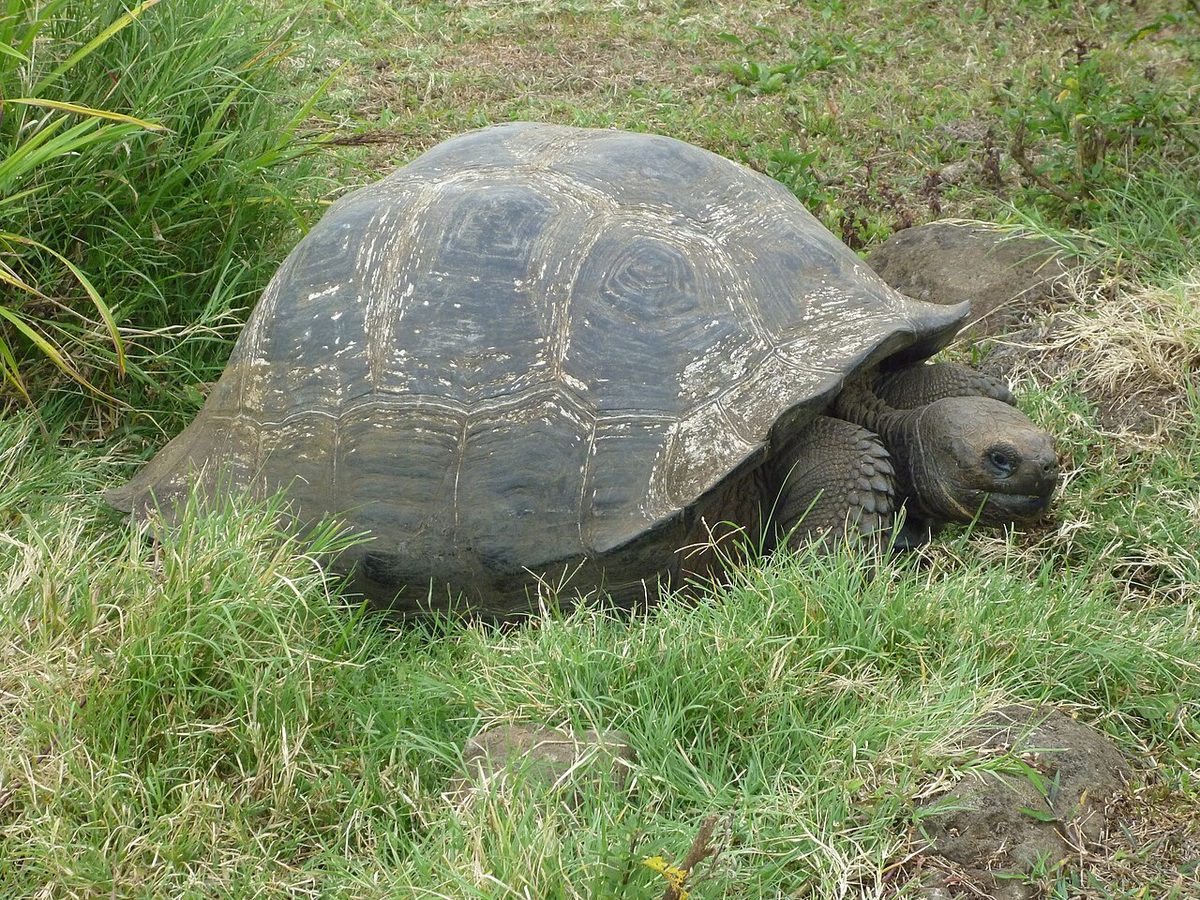
The longest living turtle in the world is Jonathan, a Seychelles giant tortoise who lives on the lawns of Plantation House, the governor's residence on Saint Helena, a British Overseas Territory in the South Atlantic. He hatched around 1832, which makes him 193 as of 2026 — the oldest known living land animal and the oldest verified tortoise in recorded history.
He is also called the oldest living chelonian known to science. "Chelonian" is simply the umbrella word for turtles, tortoises and terrapins. He marked his official 193rd birthday on 4 December 2025, and he holds a Guinness World Records title as oldest living land animal, plus a place on its "Icons" list. If you want to know how he is doing this week, his care sits with the government of Saint Helena — they are the ones to ask.
Meet Jonathan, the oldest living land animal
Jonathan is a Seychelles giant tortoise (Aldabrachelys gigantea hololissa), a subspecies of the Aldabra giant tortoise (Aldabrachelys gigantea). He weighs 400 pounds (180 kg), and he has grazed the same lawn for the past century.
How he reached Saint Helena
In 1882 he was shipped from the Seychelles — then under the British Crown colony of Mauritius — to Saint Helena, together with three other tortoises. He arrived as a gift for the governor of the day, Sir William Grey-Wilson. He was already about 50 years of age and fully grown, and he is the last surviving member of that group of four. He was not even named until the 1930s, when Governor Sir Spencer Davis gave him the name Jonathan.
Stamps, coins and an official birthday
In November 2022 Governor Nigel Phillips granted Jonathan an official birthday: 4 December, declared as 4 December 1832. Islanders held three days of celebration on 4 December 2022, with a cake made entirely from his favourite foods. A plan for his 190th birthday, drawn up in February 2022, included commemorative postage stamps and a visitor certificate showing his first known footprint. He has appeared on Saint Helena stamps and coins, met George VI and Elizabeth II in 1947, Prince Philip in 1957 and Prince Edward in January 2024, and posed with the Queen's Baton in February 2014.
Governors come and go while Jonathan stays. The tally is told two ways: some accounts say he has lived through 31 governors' terms, others count 28 governors since 1882.
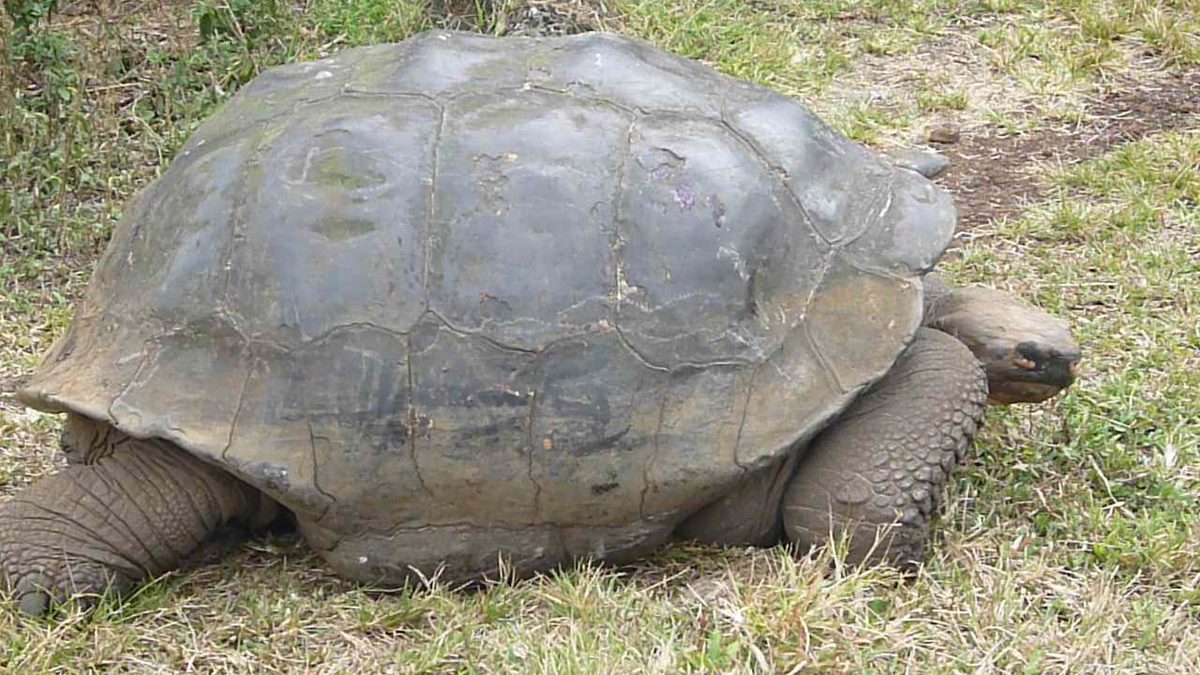
How does anyone know he is 193?
Honestly, nobody knows exactly. There is no record of Jonathan's birth, and there is no birth record for any of the famous old tortoises. Every one of these ages is an estimate, and some are contested, because researchers are almost never there when the animal hatches.
Jonathan's age is worked out backwards. He was fully grown when he landed in 1882, and Seychelles giant tortoises are fully grown at about 50 years old. That gives a hatching date no later than 1832. An early photograph backs it up: measurements taken from the picture show he was already fully mature four years after he arrived. Accounts of the picture's date differ — some place it in 1886 (it was once thought to be from 1902), others describe it as taken some time between 1882 and 1886, shortly after he came ashore.
Note that 1832 is the latest he could have hatched, not the earliest. Some experts think Jonathan could have reached the age of 200.
The ways a tortoise's age gets estimated
- Back-calculation from size and maturity — the main method used for Jonathan.
- Dated photographs, with careful measurements taken from the image.
- Carbon dating of the shell — the method behind the highest age ever claimed for a tortoise.
- Historical records — ships' voyages and gifts made to royal families and governors.
- DNA testing, which can show that one animal is a generation older than another.
Life at 190-plus: blind, no sense of smell, still grazing
Age has taken things from Jonathan. In December 2015 Saint Helena vet Joe Hollins said he was "alive and well", but blind from cataracts and no longer able to smell his food. His hearing stayed excellent.
How much sight he has left is described in different ways: some say he is blind from cataracts, some say he has lost most of his eyesight, and some say the cataracts affect his vision but he still finds his way around perfectly well. Everyone agrees he needs help locating food — and that he is far from finished. When he was about 191 years old as of 2023, one report noted the world's oldest tortoise was still randy. He still mates.
What he eats, and who feeds him
Grass, hay, and seasonal fruit and vegetables: apples, pears, bananas, lettuce, cabbage, carrots and cucumbers. Joe Hollins arrived on Saint Helena in 2009, found Jonathan in poor physical condition, and nursed him back to health by supplementing his diet. He now hand-feeds him because of the vision loss. A new diet meant to keep him healthy and extend his life was reported in January 2016, and his keepers prepare nutritional supplements for him and write down his habits and physical condition.
Who shares the lawn with him
Descriptions of his companions vary. Some say he does almost everything alongside Frederik, another male tortoise introduced to him in 1991. Others say his mate is a female called Frederica, estimated to be 170 years old. Others say he roams with three much younger resident tortoises — Frederik, David and Emma — and had an unnamed female for company until 1918. Some simply say he lives with several other tortoises. Either way he is not alone, and he is said to have a gentle personality and to enjoy the company of visitors and other animals.

The other great old tortoises
Jonathan is the oldest one alive that we know of, but his is not the highest age ever claimed. Here are the others whose names come up every time.
Adwaita — 255 years, claimed
Adwaita was an Aldabra giant tortoise who died in 2006 at the Alipore Zoological Gardens in Kolkata, India. He was reportedly given to Robert Clive, the British governor of Bengal, by the British East India Company in the 18th century, kept as a pet until Clive's death in 1774, then donated to the zoo, where he lived over 200 years. His shell measured 1.5 meters in length and he weighed 250 kilograms. He had four wives, all of whom died decades before him.
His age is where accounts part company. Some state plainly that he died at 255, based on carbon dating of his shell. Others say he is believed to have lived to 255, but that this has never been confirmed. It is the highest figure anyone claims for a tortoise, and also the shakiest.
Tu'i Malila — 189 years
Tu'i Malila was a female radiated tortoise (Astrochelys radiata) from Madagascar, born circa 1777. British explorer James Cook collected her in 1777, on his third and final voyage, and she was given to the Tongan royal family. She died in Tonga in 1966 at the age of 189, measuring 16.25 inches long, 13 inches wide and 9.5 inches tall. Guinness World Records recognised her as the oldest tortoise ever recorded until Jonathan's estimated age passed hers in 2022, and she is still described as the all-time verified record holder.
Harriet — 175 years
Harriet (c. 1830 – 23 June 2006) was a Galápagos tortoise with an estimated age of 175 at death and a weight of 150 kg. Her species is printed two ways, as Geochelone elephantopus porteri and as Chelonoidis niger. Charles Darwin collected her on Santa Cruz island during the HMS Beagle voyage in 1835, when she was about the size of a dinner plate. She was one of three tortoises Darwin brought to England, and she was given to the Beagle's captain, John Clements Wickham. She reached Australia in 1842, spent more than 100 years at the Brisbane Botanical Gardens, moved on to Fleay's Fauna Sanctuary, and spent two decades at Australia Zoo in Queensland, where she appeared on The Crocodile Hunter. She died of heart failure, nicknamed the "grand old lady". Before her death she was called the oldest known animal in the world, setting aside ages that were only surmised, and Guinness had named her the oldest living chelonian. Australia Zoo said DNA testing proved she was at least one generation older than any existing tortoise in Australia.
So who comes second?
That depends who you ask. Some accounts call Harriet's 175 years the second-oldest ever recorded, after Jonathan. Others point out that Tu'i Malila's 189 years is older, and treat her as the verified record for a tortoise that has already lived and died.
Is a tortoise really a turtle — and how long do turtles usually live?
It sounds like a trick, but yes. Tortoises are classified within the turtle family, so a tortoise is a type of turtle, and several of the longest-lived turtles are in fact tortoises. Scientists use "chelonian" for turtles, tortoises and terrapins together, and some writers simply say "land turtles". Every record-holder named above — Jonathan, Adwaita, Tu'i Malila and Harriet — is a land tortoise, not a sea or freshwater turtle. If you want the oldest named sea turtle or pond turtle, that is a different question, and the famous records do not answer it.
- Most turtle species live 10 to 80 years.
- Sea turtles and large land tortoises reach 150 years or more.
- The longest-living turtle species come close to 200 years.
- Documented Seychelles giant tortoises average 150 years — Jonathan has gone well past his own species' average.
- Some have estimated that large turtles may be able to live 400 to 500 years, though that is speculation, not a recorded age.
For scale, the average human lifespan is just under 80 years. Turtles are not the only creatures that outlast us: Greenland sharks, bowhead whales, koi and red sea urchins all run to great ages, and the ocean quahog clam can pass more than 500 years.
Why turtles outlive people
- A slow metabolism. Turtles are ectothermic — cold-blooded. They need less energy for daily functioning, which cuts the metabolic wear and tear that drives ageing in other animals.
- Better cell repair. Research suggests turtle cells have superior DNA repair, so mutations do not build up over time the way they do elsewhere.
- Tough immune responses. Their specialised immune systems appear to resist age-related deterioration better than a mammal's.
- Slow breeding. Their slow reproductive cycles fit evolutionary theories linking longer generation times to longer lifespans.
Together, this puts turtles among the longest-living vertebrates on Earth, alongside certain whale species and a few other reptiles.
Long-lived tortoise species, if you are thinking of keeping one
You do not need a giant to own a tortoise that outlives your working life. Here is what has been documented for several species, with the usual span first and the record after.
- Kleinmann's tortoise — averages about 50 years, with 100 recorded in captivity. A small tortoise from dry, arid, semi-desert country in North Africa, about eight inches long, with a yellow-brown shell marked with dark spots. Its colouring makes it popular with reptile keepers.
- Russian tortoise, also called the Afghan tortoise — averages 50 to 80 years, with some individuals reaching 100. It comes from arid and semi-arid Central Asia and parts of the Middle East, grows to 8 to 10 inches, and eats mostly grasses and vegetation.
- Marginated tortoise — averages 100 years, oldest record 150. A Mediterranean herbivore, up to 20 inches long, coloured black through to yellow. It prefers open, sunny places with plenty of vegetation, and its thick shell and low-slung body help it stay cool.
- Greek tortoise — averages 50 to 90 years, with the longest documented individual reaching 160.
- Pinta Island tortoise — averages 100 years, with 150 recorded. A giant tortoise found only on Pinta Island in the Galápagos archipelago off the coast of Ecuador, and one of 14 recognised subspecies of Galápagos giant tortoise. Adults have a domed shell, a yellowish-brown carapace and dark brown limbs, weigh around 85 to 110 pounds and measure up to 3 feet in length. The species was believed extinct in June 2012, when its last known living member, Lonesome George, died — but newer research indicates it is not extinct after all, and that a small number of individuals remain in the wild.
What these records cannot tell you
The famous ages say nothing about the practical side of keeping a tortoise, and that side changes from place to place. Rules on keeping, buying, selling and moving tortoises differ by country, so check with your nearest wildlife or agriculture office before you commit to anything. Costs vary just as much, so ask local dealers and keepers rather than trusting a figure you read online. Housing, heating, lighting, hibernation and routine health care are all best worked out with a vet near you who treats reptiles. And think this through before you start: an animal like this may well outlive you.
The bottom line
Jonathan holds the title — 193 as of 2026, hatched around 1832, still on the same Saint Helena lawn at 400 pounds (180 kg), hand-fed by his vet, blind, unable to smell his dinner, and by every account still enjoying himself. Adwaita's claimed 255 years is higher but unconfirmed. Tu'i Malila's 189 and Harriet's 175 are the other great ages. The honest lesson from all four is that these animals measure their lives in centuries, not seasons, and that even the best-known ages are careful estimates rather than certificates.
See also
- Turtle
- Aldabra giant tortoise
- Seychelles giant tortoise
- Galápagos giant tortoise
- Radiated tortoise
- Pinta Island tortoise
- Marginated tortoise
- Greek tortoise
- Russian tortoise
- Kleinmann's tortoise

 Menu
Menu
💬 Comments
Login to comment
No comments yet. Be the first to share your experience!